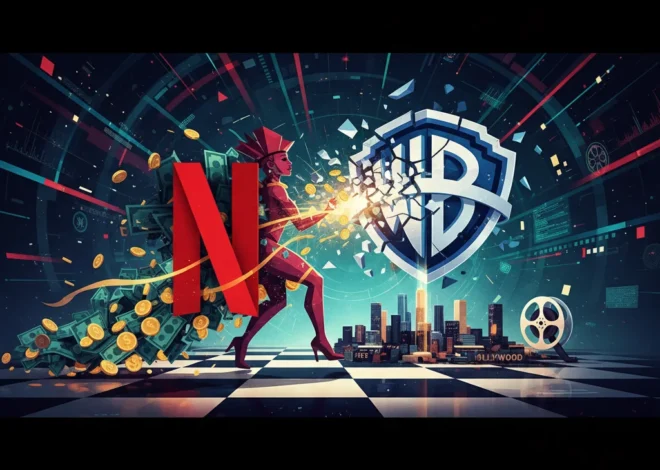
The Trump Card: How Presidential Politics and Netflix Upended an $83 Billion Media Mega-Deal
In the high-stakes world of corporate finance, mergers and acquisitions (M&A) are complex ballets of negotiation, valuation, and regulatory scrutiny. Billions of dollars hang in the balance, and investors watch every move. But what happens when the most powerful person in the world unexpectedly wades into the fray, not with a scalpel of legal reasoning, but with a sledgehammer of populist rhetoric? This was the exact scenario that unfolded when then-President Donald Trump offered his unsolicited, and highly unorthodox, analysis of the proposed $83 billion merger between AT&T and Time Warner, creating a firestorm that rippled through the stock market and the corridors of power.
The President’s comments were not just a passing remark; they were a signal of a new, unpredictable era where political sentiment could directly influence a deal’s fate, forcing investors, bankers, and economists to recalibrate their understanding of regulatory risk. This is the story of how a single presidential statement, bizarrely focused on a third-party competitor, Netflix, threw one of the decade’s largest media deals into chaos and offered a stark lesson in the volatile intersection of politics, media, and high-stakes finance.
The Deal on the Table: A Vertical Integration Power Play
To understand the gravity of the situation, we must first appreciate the monumental scale of the proposed merger. In late 2016, AT&T, a telecommunications and distribution behemoth, announced its intention to acquire Time Warner, a content empire that owned iconic assets like HBO, CNN, and the Warner Bros. film studio. This wasn’t a standard horizontal merger where two direct competitors combine (like two banks merging). This was a vertical merger—a deal designed to unite the creator of content (Time Warner) with the distributor of that content (AT&T’s wireless, broadband, and satellite networks).
The strategic logic, from AT&T’s perspective, was clear. In an evolving media landscape dominated by streaming, owning the pipes was no longer enough. The real value, and the future of the economy, was in owning the premium content that flowed through them. By acquiring Time Warner, AT&T aimed to create a vertically integrated powerhouse capable of competing with the new titans of tech and media, namely Netflix, Amazon, and Google.
For investors and the stock market, the deal was a fascinating play on the future of media consumption. It represented a bold, albeit expensive, bet that combining content and distribution would unlock immense value, create new revenue streams, and provide a formidable defense against cord-cutting and the rise of streaming-first services. The world of finance watched intently, with investment banking divisions orchestrating the massive financing and trading desks speculating on the deal’s success.
A Presidential Wrench in the Works
The deal required approval from the U.S. Department of Justice (DOJ), which scrutinizes mergers for potential antitrust violations. While vertical mergers historically faced less scrutiny than horizontal ones, the sheer size of this deal guaranteed a close look. However, no one in the financial community could have predicted the nature of the President’s intervention.
Speaking to reporters, President Trump declared he would be personally involved in the decision-making process. But the most stunning part of his commentary was his focus not on the merging parties, but on Netflix. He suggested that Netflix’s dominant market share “could be a problem” that the AT&T-Time Warner combination was meant to address. This statement was perplexing on multiple levels. Antitrust law is designed to prevent mergers that harm competition and consumers, typically by creating a monopoly. Arguing that a merger should be approved because it creates a stronger competitor to an *existing* market leader is an unconventional, if not entirely inverted, interpretation of antitrust principles.
The comment immediately sent shockwaves through the investing community. Was this a genuine, albeit unorthodox, economic argument? Or was it a smokescreen for a politically motivated attack on CNN, a Time Warner asset the President frequently criticized? The ambiguity itself became a new form of risk, a variable that couldn’t be modeled in any standard financial technology spreadsheet.
Forging New Fortunes: How London's Industrial Past is Powering a Modern Investment Boom
Deconstructing the Players and the Power Dynamics
To clarify the landscape, it’s helpful to visualize the key entities involved in this corporate and political drama. Each had its own motivations and strategic position, creating a complex web of interests.
Here’s a breakdown of the main players:
| Company / Entity | Role in the Drama | Key Assets / Position |
|---|---|---|
| AT&T | The Acquirer | Massive distribution network (wireless, broadband, DirecTV). Seeking to own premium content to secure its future. |
| Time Warner | The Target | Content empire (HBO, Warner Bros., CNN, TNT). Seeking scale and distribution muscle in a changing media world. |
| Netflix | The Disruptor / Justification | Dominant streaming player with a vast subscriber base. Its success was the strategic impetus for the merger. |
| The White House | The Wild Card | Held regulatory power with an unpredictable and politically charged agenda, particularly regarding CNN. |
The Aftermath: A Courtroom Battle and a Sobering Lesson
Despite the President’s confusing justification, his administration’s DOJ ultimately did move to block the merger. In November 2017, the DOJ filed an antitrust lawsuit, arguing that the vertical integration would give AT&T the power to charge rival distributors more for Time Warner’s “must-have” content, ultimately harming consumers. The lawsuit notably did not use the “Netflix is too big” argument, focusing instead on traditional antitrust concerns.
The move sent the case to federal court in a landmark antitrust trial. After a lengthy legal battle, a federal judge ruled in favor of AT&T and Time Warner in June 2018, rejecting the government’s arguments and allowing the merger to proceed without conditions. The court found that the government had failed to prove that the deal would substantially lessen competition. The DOJ chose not to appeal the final decision to the Supreme Court, and the $85 billion deal officially closed.
For a moment, it seemed like a victory for AT&T. However, the story doesn’t end there. The grand vision of a vertically integrated content and distribution machine never fully materialized as planned. Integrating the disparate cultures of a telecom giant and a creative media powerhouse proved immensely challenging. Saddled with massive debt from the acquisition, AT&T struggled to make the synergy work.
In a stunning reversal, less than three years after fighting a historic legal battle to acquire Time Warner (rebranded as WarnerMedia), AT&T threw in the towel. In May 2021, the company announced it would be spinning off WarnerMedia and merging it with Discovery, Inc. This move was a tacit admission that the vertical integration strategy had failed. The subsequent creation of Warner Bros. Discovery aimed to create a pure-play content company better equipped to compete in the global streaming wars—a strategy that, ironically, looked much more like the companies it was originally trying to fight.
Operation Ajax: How a 1953 Coup in Iran Forged Decades of Geopolitical Risk for Investors
Lessons for the Modern Investor
The saga of the AT&T-Time Warner merger, from presidential interference to its eventual unraveling, offers several critical lessons for those involved in finance, investing, and the broader economy.
- Political Risk is Real and Unpredictable: The era of predictable, precedent-based regulatory review is over. Investors must now factor in the potential for political and even personal motivations to influence major economic decisions. This adds a layer of uncertainty to the stock market, particularly for companies in regulated or high-profile industries.
- The Limits of Vertical Integration: The grand economic theory of combining content and distribution is compelling on paper but incredibly difficult to execute in practice. Corporate culture clashes, massive debt loads, and a lack of strategic focus can doom even the most promising mega-mergers. The ultimate spinoff of WarnerMedia serves as a cautionary tale for business leaders pursuing similar strategies.
- Antitrust in the Digital Age is Evolving: This case was a major test for antitrust enforcement in an economy dominated by tech platforms and streaming services. While the government lost, the debate it sparked about the power of vertically integrated companies continues to shape conversations in economics and law today, especially as regulators eye giants like Apple, Amazon, and Google.
- The Enduring Power of Content: Ultimately, AT&T’s costly experiment confirmed a long-held belief in the media industry: content is king. AT&T’s decision to spin off its media assets to form a content-focused behemoth underscores that in the streaming wars, the ultimate victors will be those who can create, own, and distribute the most compelling stories, regardless of the pipes they travel through.
The story that began with a President’s strange comments about Netflix concluded with the creation of a new media giant and a powerful lesson on corporate hubris. It serves as a stark reminder that in the modern economy, success requires more than just financial capital and strategic vision. It demands a keen understanding of shifting political winds, the complexities of technological disruption, and the timeless, unwavering demand for a good story.
The Pension Paradox: Is the UK Government Sabotaging Your Retirement Savings?

Related Posts

Beyond the Balance Sheet: Why Major Economic Decisions Can Never Escape Politics

Beyond the Balance Sheet: The Air India Crash Allegations and a Sobering Lesson in Investment Risk