A New World Order: Navigating Geopolitical Risk, Economic Realism, and the Future of Prosperity
The global landscape is shifting beneath our feet. The era of predictable growth and stable geopolitical alliances that defined the late 20th century has given way to a more fractured, uncertain, and complex world. For investors, business leaders, and finance professionals, the old playbooks are no longer sufficient. We are grappling with the rise of great power competition, the unwinding of long-held economic dogmas, and a technological revolution that is fundamentally reshaping what “value” even means.
To make sense of this new reality, we need fresh perspectives that cut through the noise. A recent collection of books on economics and geopolitics offers just that—a powerful trilogy of insights into the forces shaping our future. From the urgent need for political pragmatism in a post-Brexit Britain to the seismic fallout from the US-China rivalry and the very nature of wealth in a knowledge-based economy, these works provide a crucial roadmap for navigating the challenges and opportunities ahead. Let’s delve into these critical themes and explore what they mean for the future of finance, investing, and global commerce.
The End of Ideology: Why Pragmatism is Britain’s Only Path Forward
For decades, a specific brand of free-market ideology dominated Western economic thought. In the UK, this culminated in the push for Brexit, often framed by its proponents as a move toward a “libertarian utopia” unshackled from European regulation. However, as Financial Times chief economics commentator Martin Wolf argues in his book, The Interest of the State, this pursuit of ideological purity has come at a steep price. The reality has been economic instability, diminished global standing, and a stark lesson in the limits of dogma.
Wolf’s central thesis is a powerful call for a return to political realism. He contends that a successful state cannot be run on abstract theories; it requires a pragmatic, competent, and steady hand. A state’s primary interest, he argues, is to provide stability, security, and essential public goods—the very foundations upon which a thriving economy is built. According to the analysis presented in the Financial Times review, this means abandoning fantasies of a minimal state and instead focusing on what works: strategic industrial policy, robust institutions, and a clear-eyed assessment of the nation’s place in the world.
For those in the world of finance and investing, this is more than just a political debate. The stability of the stock market, the reliability of government bonds, and the overall investment climate are directly tied to the competence of the state. When political dogma leads to unpredictable policy and economic self-harm, it creates immense risk and uncertainty, crippling long-term trading and investment strategies. Wolf’s argument suggests that the most valuable asset a country can have is not a particular ideology, but a government grounded in realism and focused on delivering tangible results.
Beyond the Checkout Cart: The PandaBuy Breach and Its High-Stakes Lessons for the Global Economy
The Great Rupture: Deconstructing the New Era of US-China Competition
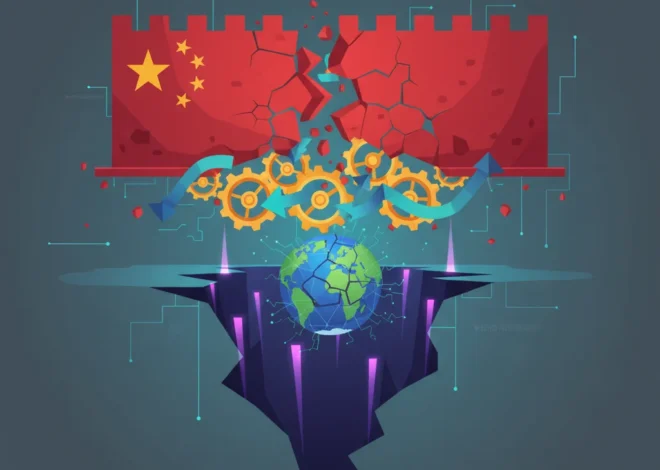
While Britain grapples with its internal economic philosophy, the entire global economy is being reshaped by an external force: the escalating rivalry between the United States and China. In The Contest of the Century, author Geoff Dyer chronicles the dramatic shift from an era of engagement and mutual economic benefit to one of open and often hostile competition. This is not a temporary spat; it is a fundamental realignment of the global order with profound implications for every sector, from banking to technology.
The core of this “new era” is a geopolitical faultline that is forcing nations and corporations to choose sides. The idea that business and politics could be kept separate is now obsolete. The competition is playing out across multiple fronts: trade tariffs, technological supremacy (especially in semiconductors and AI), control over global supply chains, and influence in international institutions. This has moved beyond simple economics and into the realm of national security, where every transaction and investment is viewed through a strategic lens.
To understand the depth of this transformation, consider the differences between the two eras:
| Domain | The Era of Engagement (c. 1990-2015) | The Era of Competition (c. 2016-Present) |
|---|---|---|
| Trade & Investment | Focus on integration, efficiency, and cost reduction. Global supply chains optimized for lowest cost. | Focus on resilience, security, and “friend-shoring.” Supply chains reconfigured to mitigate geopolitical risk. |
| Technology | Shared standards and open collaboration. US tech firms dominant in the Chinese market. | Technological decoupling. “Chip wars,” battles over AI, 5G, and competing tech ecosystems. Rise of Chinese financial technology (fintech). |
| Geopolitics | Belief that economic integration would lead to political liberalization in China. | Recognition of deep ideological and systemic rivalry. Alliances are being solidified along geopolitical lines. |
| Market Impact | Lower inflation, higher corporate profits, and a relatively stable global stock market environment. | Increased volatility, supply chain-driven inflation, and a new layer of geopolitical risk for investors to price in. |
This new reality demands a complete overhaul of risk assessment for global investors. The fallout from this rivalry will continue to shape commodity prices, currency trading, and the fortunes of multinational corporations for decades to come. As Dyer’s analysis makes clear, navigating the global economy now requires a deep understanding of geopolitics (source).
The Knowledge Economy 2.0: Where Prosperity Truly Comes From
What is the true source of a nation’s wealth? For centuries, economists focused on land, labor, and capital. But in our modern world, the most critical asset is intangible: knowledge. In his book, The Second Great Divergence, MIT’s César Hidalgo offers a groundbreaking framework for understanding this new reality. He argues that prosperity is a direct function of a society’s ability to accumulate and combine knowledge.
Hidalgo introduces the concept of a “personbyte”—a unit of practical knowledge held by one person. A simple product, like a wooden chair, might require only a few personbytes of combined knowledge. A complex product, like a smartphone or a commercial aircraft, requires networking millions of personbytes from thousands of individuals across vast, intricate supply chains. Therefore, economic development is not just about having smart people; it’s about a society’s capacity to build the networks that allow specialized knowledge to be combined at scale and speed.
This has profound implications for how we view the modern economy:
- The Value of Networks: The most prosperous cities and nations are those that act as massive hubs for connecting diverse “personbytes.” This is why innovation clusters like Silicon Valley are so powerful.
- Intangible Assets: For modern companies, especially in sectors like financial technology and software, the most valuable assets are not on the balance sheet. They are the collective knowledge of their teams and the networks they operate within.
- The Speed of Innovation: The speed at which a company or an economy can learn and combine new knowledge is the primary determinant of its competitiveness. This is the engine of disruptive technologies like AI and blockchain, which are essentially new ways of networking and verifying information.
Hidalgo’s work forces us to rethink everything from education policy to corporate strategy. Investing in human capital is crucial, but investing in the social and technological infrastructure that allows that capital to connect and collaborate is even more so. For those in fintech and banking, this is the very essence of their business—creating trusted networks for the exchange of information and value.
Beyond the Piggy Bank: Why Financial Education is the Ultimate Investment in Our Future Economy
Conclusion: A New Playbook for a World in Flux
The message from these three distinct analyses converges on a single, powerful conclusion: the world has changed, and our thinking must change with it. The comfortable assumptions of the post-Cold War era are gone. Success in this new environment requires a clear-eyed realism over ideological comfort, a sophisticated understanding of geopolitical risk, and a deep appreciation for knowledge as the ultimate economic driver.
For business leaders, this means building resilient supply chains and embedding geopolitical analysis into core strategy. For those in finance and trading, it means pricing in a new class of political risks and identifying opportunities in the burgeoning knowledge economy. For policymakers, it means fostering a pragmatic, competent state capable of navigating global competition and investing in the networks that create true prosperity. The path forward is complex and fraught with challenges, but by embracing these new realities, we can begin to chart a course through the uncertainty and build a more resilient and prosperous future.