The New Political Risk: Is Crony Capitalism Threatening Your US Investments?
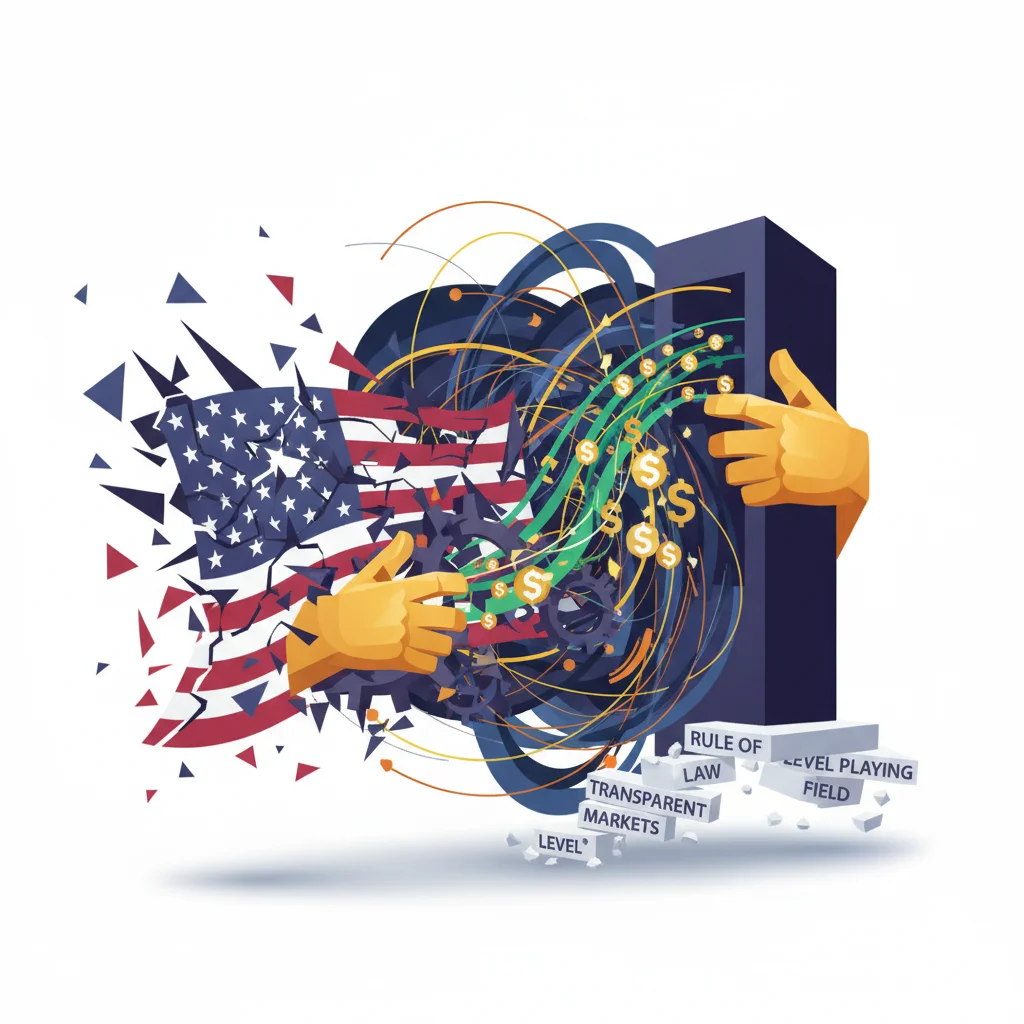
For decades, the United States has been the bedrock of the global financial system, a safe harbor where the rule of law, transparent markets, and a level playing field were considered unshakeable truths. Investors from around the world have poured capital into US assets, confident that they were participating in an economy built on meritocracy and fair competition. But what happens when the lines between political power and corporate profit begin to blur? What is the real cost to the economy—and your portfolio—when preferential treatment threatens to replace free-market principles?
This isn’t a theoretical exercise. The increasing perception of “crony capitalism,” a system where success in business depends on close relationships between business people and government officials, is casting a long shadow over the American economy. As noted in a sobering analysis by the Financial Times, the ethical landscape of American governance has shifted, introducing a new and unpredictable variable into the world of finance and investing. This trend, if left unchecked, could fundamentally alter the risk profile of US assets and challenge the nation’s long-held economic supremacy.
Understanding the Threat: What is Crony Capitalism?
At its core, crony capitalism is the antithesis of a healthy free-market economy. In a functional market, capital flows to the most innovative and efficient enterprises. Companies succeed by offering better products, superior services, or more competitive prices. This relentless competition drives economic growth, fosters innovation, and ultimately benefits consumers.
Crony capitalism short-circuits this entire process. Instead of the boardroom or the R&D lab, the most important deals are struck in the halls of power. Success becomes a function of who you know, not what you can do. This can manifest in several ways:
- Favorable Regulation: Governments can create or dismantle regulations to benefit specific, politically connected companies, handing them an unfair advantage over their rivals.
- Bailouts and Subsidies: Taxpayer money is used to prop up failing businesses owned by friends of the administration, privatizing profits while socializing losses.
- Selective Enforcement: Laws are enforced vigorously against political opponents or unconnected businesses, while allies receive a pass.
- No-Bid Contracts: Lucrative government contracts are awarded without a competitive bidding process, often at inflated prices.
When these behaviors become systemic, they poison the well of the entire economy. The risk is that the US, long the gold standard for market transparency, begins to exhibit characteristics more commonly associated with unstable emerging markets, where political risk is a primary concern for every investor (source). For those involved in trading and banking, this uncertainty fundamentally changes the calculus of risk and reward.
The ROI of a Christmas Toy: An Investor's Guide to Social Impact and Economic Resilience
From Theory to Reality: Conflicts and Market Consequences
The concerns are not merely academic. The Trump administration provided several high-profile examples that blurred the lines between public service and private gain. These instances serve as powerful case studies in how cronyism can introduce systemic risk into the financial system.
Consider the case of Carl Icahn, the activist investor who was appointed as a special adviser on regulatory reform. During his tenure, he advocated for changes to a biofuels regulation that would have directly benefited a refinery in which he held a major stake. While he ultimately resigned, the situation highlighted a glaring conflict: a key adviser was in a position to shape policy that could generate personal profit (source). This is the very definition of regulatory capture, where industry insiders write the rules for their own benefit.
Below is a breakdown of a few illustrative examples and their potential impact on the broader economy and stock market:
| Case/Entity | Apparent Conflict of Interest | Potential Impact on the Market & Economy |
|---|---|---|
| Carl Icahn (Investor & Adviser) | Advised on regulatory changes (biofuels) that could directly benefit his significant personal investments in an oil refinery. | Distorts energy markets, creates policy uncertainty for competitors, and signals that regulations can be bought by the well-connected. |
| Scott Pruitt (EPA Head) | Known for his close ties to the fossil fuel industry, he led an agency tasked with regulating that very industry, often rolling back environmental protections. | Creates long-term environmental and economic liabilities. Misprices risk by ignoring climate-related financial dangers. Favors legacy industries over innovative green technology. |
| Deutsche Bank Settlement | The Trump Organization was a major debtor to Deutsche Bank at the same time the Justice Department was negotiating a multi-billion dollar settlement with the bank. | Erodes faith in the impartiality of the justice system. Creates the perception that major banking institutions can receive lenient treatment based on their relationship with the executive branch (source). |
These are not isolated incidents but part of a pattern that threatens the core tenets of American economics. When capital allocation is driven by political favoritism rather than market fundamentals, the entire economy suffers. Innovation is stifled, competition withers, and the nation’s productive capacity is diminished.
The Toy Swap Economy: What a Local Event Reveals About the Future of Finance, Fintech, and Investing
The Investor’s Playbook for Navigating a Politicized Market
For investors, finance professionals, and business leaders, ignoring this new layer of political risk is no longer an option. The rules of the game are changing, and investment strategies must adapt. So, how can one protect their assets in an environment where political connections can trump market logic?
- Re-evaluate Geopolitical Risk: For too long, investors have treated US assets as virtually risk-free from a governance perspective. It’s time to incorporate US political and regulatory risk as a key factor in any portfolio allocation. This may mean increasing diversification into markets with strong, independent institutions and a robust rule of law.
- Prioritize Strong Corporate Governance (The ‘G’ in ESG): In an era of cronyism, companies with strong, independent boards, transparent accounting, and a commitment to ethical behavior are more resilient. The “Governance” aspect of ESG investing has never been more critical. These companies are less likely to be entangled in political scandals and better equipped to navigate a volatile regulatory landscape.
- Focus on True Competitive Advantage: Look for companies whose success is built on defensible moats: intellectual property, network effects, strong brand loyalty, or superior technology. These are businesses that can thrive with or without political favors. A company whose primary asset is its lobbying budget is a fragile investment.
- Stress-Test for Regulatory Shocks: When analyzing a company, particularly in highly regulated sectors like energy, healthcare, and banking, actively consider how sudden, politically motivated changes in regulation could impact its bottom line. The stability of the regulatory framework can no longer be taken for granted.
The Great Disconnect: Why a Strong US Economy Feels So Bad and What It Means for Your Investments
The Ultimate Price of a Rigged Game
The foundation of a prosperous economy is trust—trust in the currency, trust in the law, and trust that the game is not rigged. The rise of crony capitalism directly attacks this foundation. It creates a vicious cycle where a lack of trust leads to capital flight, which in turn weakens the economy and encourages even more corruption as players fight over a shrinking pie.
This is more than just a political debate; it is a fundamental issue of financial technology and market structure. The integrity of the US stock market and the stability of the global financial system depend on the perception and reality of a fair playing field. As investors and stewards of capital, we must demand transparency and hold both our corporate and political leaders accountable. The long-term health of our portfolios—and our economy—depends on it.