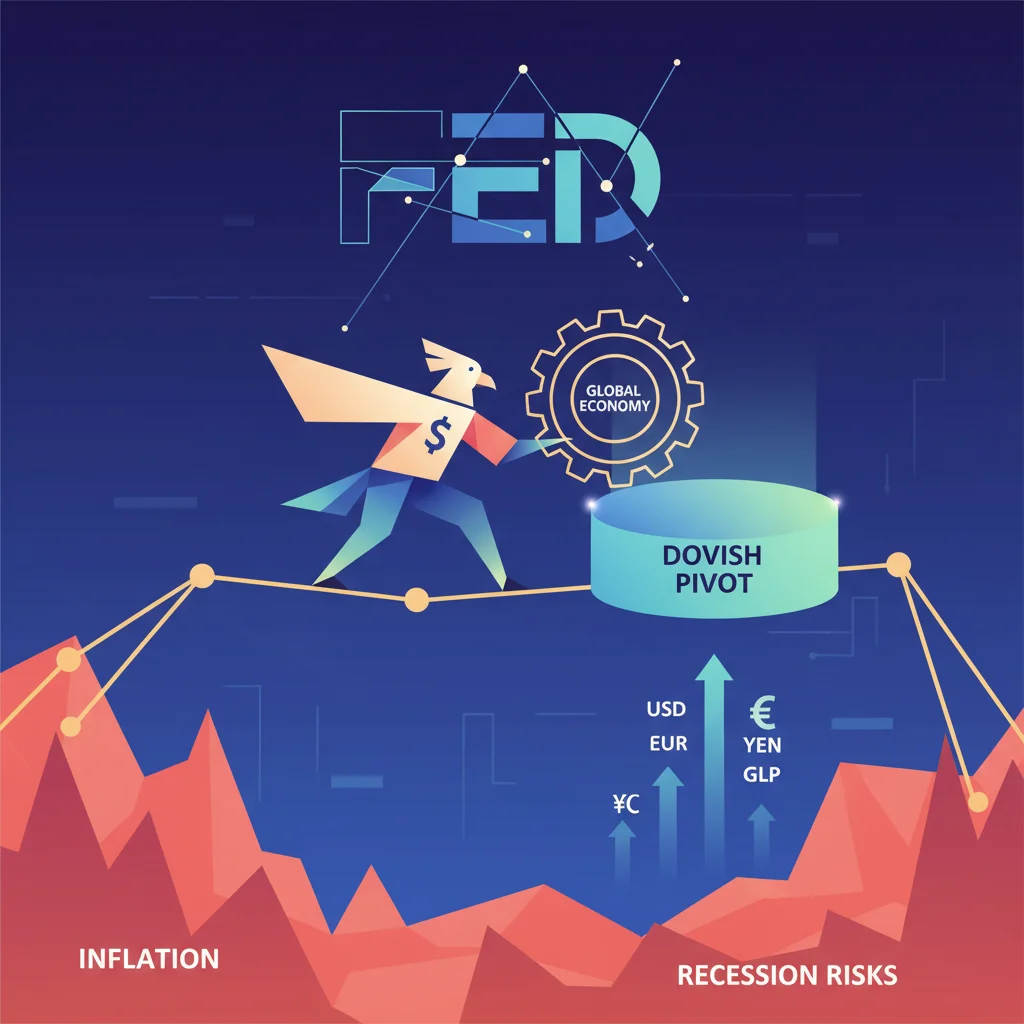
The Fed’s High-Wire Act: Is a Dovish Pivot on the Horizon for the Global Economy?
The global financial world is holding its collective breath. All eyes are on one institution: the U.S. Federal Reserve. As Chairman Jerome Powell and the Federal Open Market Committee (FOMC) prepare for their next meeting, a single, trillion-dollar question hangs in the air: Will they finally signal a “dovish” pivot? This isn’t just jargon for those in high finance; the answer will have profound implications for the stock market, the broader economy, your mortgage rate, and the future of global investing.
For months, the Fed has maintained a staunchly “hawkish” stance, keeping interest rates at a two-decade high to combat the most aggressive inflation seen in a generation. This tight monetary policy has acted as a powerful brake on the economy. Now, with inflation showing signs of cooling, investors are clamoring for a sign—any sign—that the central bank is ready to ease up and begin cutting rates. But the path forward is anything but clear, fraught with conflicting data and the ever-present risk of a policy misstep. Let’s delve into the complexities facing the Fed and what its next move means for you.
Decoding the Fed’s Language: Dovish vs. Hawkish Explained
Before we explore the current dilemma, it’s crucial to understand the language of central banking. When analysts describe a central bank’s policy, they often use ornithological terms: “hawkish” and “dovish.”
- Hawkish Stance: A “hawk” prioritizes controlling inflation above all else. They favor higher interest rates and tighter monetary policy to cool down an overheating economy. This makes borrowing more expensive for consumers and businesses, which slows spending and, in theory, brings prices down. The downside? It can also slow economic growth and potentially lead to a recession.
- Dovish Stance: A “dove” is more concerned with promoting full employment and economic growth. They favor lower interest rates and more accommodative monetary policy. This encourages borrowing and spending, stimulating the economy. The risk here is that if policy is too loose, it can allow inflation to take off.
For the past two years, the Fed has been firmly in the hawkish camp. The upcoming meeting is pivotal because the market is desperately looking for clues of a transition—a “dovish pivot”—which would signal that interest rate cuts are on the horizon. This signal is what could ignite the next major move in financial markets.
The Data Dilemma: Why the Fed is Walking a Tightrope
The Fed’s decision-making process is not based on guesswork; it is “data-dependent.” This means every new report on inflation, employment, and economic growth is scrutinized to an incredible degree. The problem right now is that the data is painting a confusing picture.
On one hand, inflation has fallen significantly from its peak. On the other, recent reports have been stubbornly “sticky,” coming in hotter than expected and reminding policymakers that the fight isn’t over. According to the Financial Times, investors are keenly awaiting the Fed’s new economic projections to see how these mixed signals have shaped the committee’s outlook. The labor market, meanwhile, continues to show surprising strength, which complicates the narrative of a cooling economy that would justify rate cuts.
This creates a precarious balancing act. If the Fed cuts rates too soon, it risks reigniting inflation, undoing all the painful work of the past two years. If it waits too long, the restrictive policy could finally crack the economy, triggering a recession and widespread job losses. The stakes could not be higher.
To illustrate the conflicting signals the Fed is grappling with, consider the following key economic indicators:
| Economic Indicator | Recent Trend (Argument for a Dovish Pivot) | Recent Trend (Argument for a Hawkish Stance) |
|---|---|---|
| Inflation (CPI/PCE) | Headline inflation is well below its 2022 peak of over 9%. | Recent monthly readings have been “sticky” and higher than forecast, particularly in the service sector. |
| Labor Market | Wage growth has started to moderate, easing fears of a wage-price spiral. | Job creation remains robust and the unemployment rate is still near historic lows, suggesting economic resilience. |
| Consumer Spending | Some signs of slowing retail sales as consumers feel the pinch of high rates. | Overall consumer spending has been surprisingly resilient, supported by a strong job market. |
| GDP Growth | Forward-looking indicators suggest a potential slowdown in economic activity. | Recent GDP reports have consistently beaten expectations, avoiding a recession thus far. |
This table highlights the central tension: while progress has been made, the economy has not cooled enough to give the Fed a clear green light for rate cuts.
Fiscal Feud or Financial Fact? Unpacking the Row Over the UK's Finances
The “Dot Plot” and Quantitative Tightening: Reading the Tea Leaves
Beyond the official statement, two key components of the Fed’s communication will be under the microscope: the Summary of Economic Projections (SEP), which includes the famous “dot plot,” and any commentary on Quantitative Tightening (QT).
The Dot Plot: This is a chart that anonymously maps out where each of the 19 FOMC participants expects the federal funds rate to be at the end of the next few years. While not an official promise, it provides invaluable insight into the collective thinking of the committee. The market will be watching to see if the median projection for 2024 still indicates three quarter-point rate cuts, as it did in the last projection. A shift to showing only two cuts would be seen as hawkish and could send a chill through the stock market. Conversely, if the plot still shows three or more, it would reinforce the dovish narrative that investors are hoping for (source).
Quantitative Tightening (QT): This is the other, less-discussed tool of monetary tightening. It’s the process of the Fed shrinking its massive balance sheet by letting its bond holdings mature without reinvesting the proceeds. This effectively removes money from the financial system, tightening financial conditions. Recently, there has been growing discussion among Fed officials about slowing the pace of QT. Any formal announcement or even a strong hint that they are considering this would be a significant dovish signal, suggesting the central bank is preparing to ease its grip on the economy.
China's Economic Engine Sputters: What a Three-Year Low in Services Means for Global Investors
Global Ripples: Why the World Watches the Fed
The Federal Reserve’s decisions do not happen in a vacuum. As the issuer of the world’s primary reserve currency, the Fed is effectively the central bank to the world. A dovish or hawkish stance has massive global consequences.
A hawkish Fed (higher U.S. interest rates) tends to strengthen the U.S. dollar. This makes it more expensive for other countries to buy goods priced in dollars (like oil) and to service their dollar-denominated debt. It puts pressure on other central banks to raise their own rates to defend their currencies, even if their domestic economies are weak.
Conversely, a dovish pivot and the prospect of lower U.S. rates can weaken the dollar, providing relief to the global economy. This is particularly relevant now, as other major central banks face their own unique challenges. For example, the Bank of Japan is contemplating its first interest rate hike in 17 years to exit its ultra-loose policy, a move whose timing could be influenced by the Fed’s actions (source). The global dance of monetary policy is intricate, and the Fed is almost always the one leading.
Implications for Your Portfolio and the Future of Finance
So, what does this all mean for investors, business leaders, and even those in emerging fields like fintech and blockchain? The outcome of the Fed’s messaging will set the tone for asset allocation and trading strategies for months to come.
- A Dovish Signal: If the Fed delivers the dovish message the market craves, it would likely be a powerful tailwind for risk assets. We could see a rally in the stock market, particularly in growth-oriented sectors like technology and consumer discretionary stocks that are sensitive to interest rates. Lower rates reduce the cost of capital for innovative companies, making investments in financial technology and other R&D-heavy sectors more attractive. It could also provide a boost to the blockchain and crypto space, which has historically thrived in low-rate, high-liquidity environments.
- A Hawkish Surprise: If Powell emphasizes that the inflation fight is far from over and the dot plot shows fewer cuts than expected, it could trigger a market sell-off. Investors would likely rotate into more defensive sectors like consumer staples and healthcare. Bond yields would likely rise, and the dollar would strengthen. This environment would be challenging for high-growth, non-profitable tech companies and could put further pressure on capital-intensive industries.
The New Power Play: Why Wall Street's Giants Are Betting Billions on Big Oil's Infrastructure
Conclusion: Navigating the Uncertainty
The Federal Reserve is at a critical juncture in modern economics. It is tasked with achieving a “soft landing”—a delicate maneuver where inflation is brought back to its 2% target without triggering a damaging recession. The upcoming meeting will provide the clearest indication yet of whether officials believe they are on the right path.
For investors and business leaders, the key is to remain agile. The path of monetary policy is rarely a straight line. While the consensus is leaning towards eventual rate cuts, the timing and pace remain highly uncertain. The Fed’s message will be dissected word by word, and the market’s reaction will be swift. Whether we get a clear dovish signal or a dose of hawkish reality, one thing is certain: the Fed’s high-wire act is far from over, and the entire world will be watching to see if they can make it to the other side.

Related Posts
UK’s Fiscal Surprise: Decoding the December Dip in Government Borrowing and What It Means for Investors
UK’s Unexpected Fiscal Breather: Decoding the December Borrowing Drop and Its Impact on the Economy
