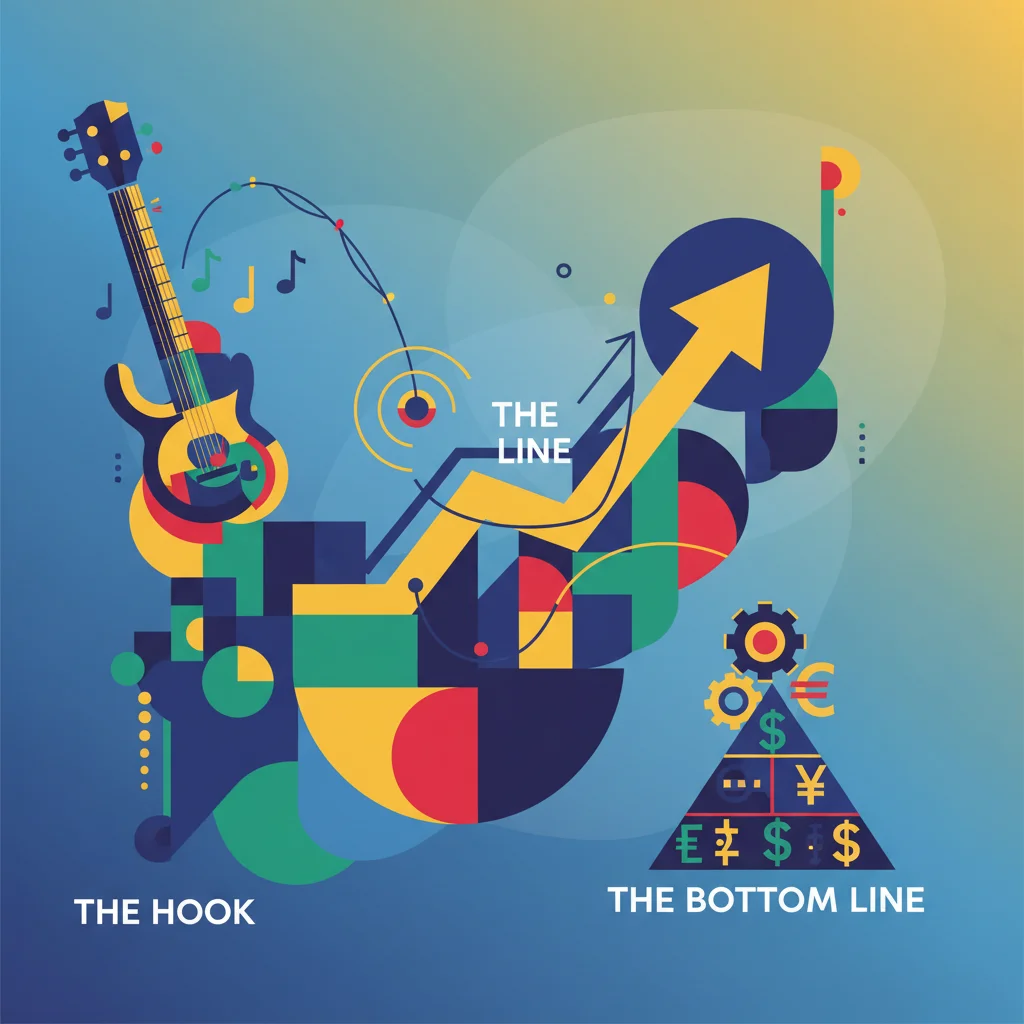
The Day Tripper Principle: How a Beatles Riff Unlocks the Code to Modern Investing and Finance
The Hook, the Line, and the Bottom Line
In the autumn of 1965, a palpable pressure was mounting on The Beatles. Fresh off their monumental Shea Stadium concert and with the holiday season looming, their record label demanded a new hit single. The result, born from what John Lennon later called a moment of creative urgency, was “Day Tripper.” While the lyrics offered a wry commentary on weekend hippies, the song’s true legacy was forged in its opening seconds: a gritty, blues-inflected, and instantly unforgettable guitar riff. According to the Financial Times, this musical hook wasn’t just catchy; it was a declaration of war in the burgeoning “battle of the riffs” against contemporaries like The Rolling Stones and The Kinks.
This simple, twelve-bar-blues-based sequence became one of the most iconic musical phrases of the 20th century. But its power extends far beyond musicology. For those navigating the complex worlds of finance, investing, and business strategy, the “Day Tripper” riff serves as a powerful metaphor for the single most important element of success: the “killer riff.” This is the core, repeatable, and defensible idea that defines a company’s value, an investor’s thesis, or a new technology’s disruptive potential. In today’s hyper-competitive economy, identifying or creating such a riff is the difference between a one-hit wonder and a chart-topping, multi-generational success.
Deconstructing the Riff: The Anatomy of a Market-Beating Idea
What made the “Day Tripper” riff so effective? It wasn’t just a random collection of notes; it was a masterclass in strategic design, with principles that translate directly into the language of modern economics and business. Understanding its components allows us to develop a framework for evaluating investment opportunities and corporate strategies.
1. Simplicity and Memorability
The riff is simple enough for a novice guitarist to learn, yet distinctive enough to be recognized instantly. This is the essence of a powerful value proposition. The most successful companies can articulate their core function in a single, memorable sentence. Google “organizes the world’s information.” Stripe provides “payments infrastructure for the internet.” This clarity cuts through market noise, making the business understandable to customers, employees, and, crucially, investors. In the stock market, companies with convoluted or opaque business models often trade at a discount because investors struggle to grasp their fundamental “riff.”
2. Technical Excellence and Scalability
While simple in concept, the riff’s execution—its tone, timing, and swagger—was flawless. In business, this is operational excellence. A brilliant idea is worthless without the ability to execute it consistently and at scale. Amazon’s “riff” isn’t just selling things online; it’s the incredibly complex and efficient logistics and cloud computing network that underpins it. This is the “how” that transforms a simple idea into a global economic force. The scalability of a business model is paramount for long-term growth, allowing a company to replicate its success across new markets and product lines, much like a riff repeating through a song’s verses and choruses.
3. Disruptive Power
In 1965, the riff’s raw, slightly distorted sound stood in stark contrast to the cleaner pop sensibilities of the time. It was an intentional disruption. This is the hallmark of transformative innovation in financial technology. The “riff” of fintech challengers wasn’t to build a better bank branch; it was to create a digital-first, low-fee, user-centric experience that made traditional banking feel archaic. Similarly, the concept of blockchain introduces a new riff—decentralized trust—that challenges the very foundation of centralized financial intermediaries. Identifying these disruptive riffs early is a cornerstone of successful venture capital and growth investing. The Price of a Handshake: Germany's Economic Engine Rattled by a Far-Right Taboo
The Modern “Battle of the Riffs”: From Fintech to Blockchain
The competitive landscape The Beatles faced is mirrored in today’s market. Companies are locked in a constant battle to create the most compelling and sticky “riff” to capture consumer attention and investment capital. This dynamic is particularly evident in the technology and finance sectors.
Consider the war for your digital wallet. The “riff” of traditional credit card companies like Visa and Mastercard is their ubiquitous acceptance and robust security network. Apple Pay’s riff is seamless integration into its hardware ecosystem. PayPal’s is its simplicity and early-mover advantage in online payments. Now, Buy Now, Pay Later (BNPL) firms have introduced a new riff based on installment payments and credit accessibility. Each is vying for dominance, and the market will ultimately reward the one with the most resonant and defensible hook. A recent report from McKinsey & Company highlights that successful fintechs are those that focus on a specific, scalable “niche” before expanding, perfecting their core riff before composing a symphony.
This battle extends into the world of high-frequency trading and institutional investing. Quantitative hedge funds build their entire empires on proprietary algorithms—highly complex, mathematical “riffs” designed to exploit market inefficiencies. These closely guarded secrets are their competitive advantage, and firms spend billions to refine them and protect them from rivals. A successful algorithm, like a hit song, can generate enormous returns until the market adapts or a competitor writes a better one.
A Framework for Identifying a “Killer Riff” in Your Portfolio
For investors and business leaders, the challenge is to distinguish a durable, long-term “killer riff” from a fleeting, one-hit wonder. A strong business riff is synonymous with what Warren Buffett calls a “durable competitive advantage” or a “moat.” Below is a framework for analysis.
| Characteristic | Strong Riff (High-Fidelity Investment) | Weak Riff (Low-Fidelity Speculation) |
|---|---|---|
| Scalability | Low marginal cost for each new user (e.g., software, digital platforms). Model can be replicated globally. | High marginal cost; growth is capital-intensive and linear (e.g., traditional consulting, physical manufacturing). |
| Defensibility (Moat) | Protected by network effects, high switching costs, intellectual property, or strong brand loyalty. | Easily replicated by competitors; little to no brand loyalty; competes solely on price. |
| Customer Stickiness | Becomes deeply integrated into a customer’s life or a business’s workflow (e.g., Microsoft Office, an iPhone). | Transactional relationship; customers can easily switch to a competitor for a better price or feature. |
| Profitability | Commands high-profit margins due to unique value. Demonstrates clear path to sustainable free cash flow. | Operates on razor-thin margins; struggles for profitability; relies on continuous external funding. |
| Innovation Pipeline | The core riff is a platform for future innovations and new revenue streams (e.g., Amazon’s e-commerce leading to AWS). | A single-product or single-feature company with no clear plan for evolution. |
Analyzing a company through this lens helps strip away the market hype and focus on the fundamental drivers of long-term value. A company with a strong score across these characteristics is more likely to be a “Beatles” than a “one-hit wonder.” Beyond the Ballot Box: Decoding the Financial Shockwaves of Honduras's High-Stakes Election
According to Harvard Business Review, true disruptive innovations often start by serving overlooked market segments, establishing their riff in a less competitive space before moving upmarket to challenge incumbents. This is a key pattern for investors to watch for when hunting for the next great economic riff.
Conclusion: The Timeless Rhythm of Value Creation
More than half a century after its release, “Day Tripper” endures. Its central riff remains a masterclass in grabbing and holding attention. The lesson for the modern leader, investor, and entrepreneur is profound. In an economy saturated with noise and complexity, success is not about being everything to everyone. It’s about finding, perfecting, and scaling one brilliant, defensible idea.
Whether you are evaluating a new financial technology, assessing a company on the stock market, or formulating your own business strategy, ask yourself: What is the “killer riff”? Is it simple, scalable, and defensible? Does it have the power to not only capture the market’s attention but to become the defining rhythm of an entire industry? By applying the Day Tripper Principle, you can begin to distinguish the timeless classics of value creation from the fleeting noise of the market. Europe's €7 Billion Green Paradox: Why Climate Funds Are Trapped in Red Tape

Related Posts

UK’s Fiscal Surprise: Decoding the December Dip in Government Borrowing and What It Means for Investors

UK’s Unexpected Fiscal Breather: Decoding the December Borrowing Drop and Its Impact on the Economy
