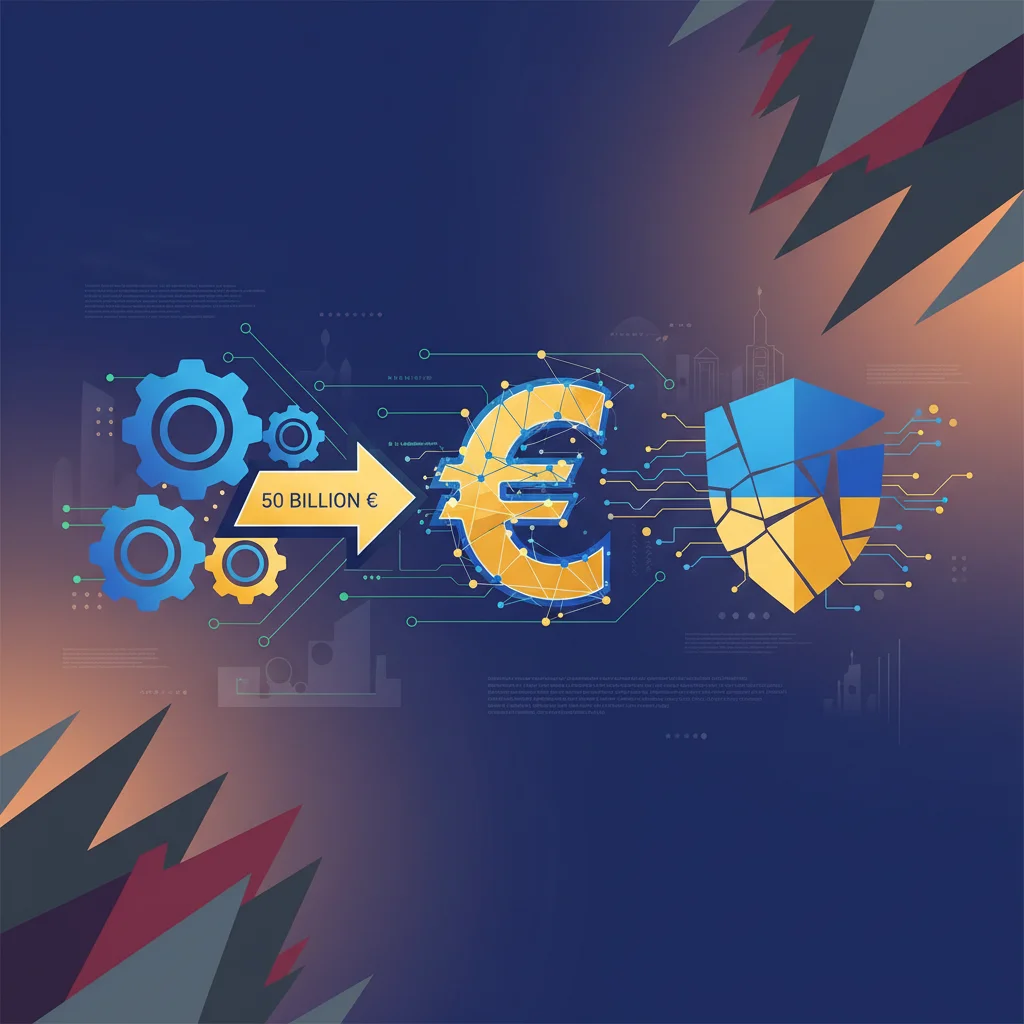
High-Stakes Economics: Deconstructing the EU’s €50 Billion Financial Gambit for Ukraine
In the intricate world of international relations, money doesn’t just talk; it shouts. It sets policy, forges alliances, and, in the case of Ukraine, provides a critical lifeline in the face of aggression. Recently, the European Union navigated a political minefield to approve a crucial €50 billion aid package for Ukraine, a decision that reverberated through the global financial markets. However, calling this a straightforward victory would be a gross oversimplification. The deal, born from intense negotiation and compromise, is a masterclass in the complex interplay of modern economics, national sovereignty, and the future of the European economy.
This wasn’t merely a budgetary allocation; it was a high-stakes chess match played on the grandest scale. For investors, finance professionals, and business leaders, understanding the nuances of this “imperfect solution” is essential. It reveals deep truths about the EU’s decision-making capabilities, the stability of the Eurozone, and the innovative, sometimes controversial, financial tools being considered to reshape the landscape of geopolitical finance.
The Orban Obstacle: A Union Held Hostage
The primary narrative leading up to the agreement was the steadfast opposition from one man: Hungarian Prime Minister Viktor Orbán. The EU operates on the principle of unanimity for major budgetary decisions, giving any single member state immense leverage. Orbán, citing concerns over corruption in Ukraine and the need to protect EU funds, effectively held the entire €50 billion package hostage. This political gridlock sent ripples of uncertainty across the stock market, as investors weighed the potential consequences of a fractured European response.
The stalemate forced EU leaders to explore a “Plan B”—a more complex arrangement involving a coalition of 26 member states that would bypass Hungary entirely. While feasible, this alternative was far from ideal. It would have been slower, more fragmented, and would have projected an image of a divided Union, a signal that would have been celebrated in Moscow and scrutinized in Washington and Beijing. The pressure was immense, not just to fund Ukraine, but to demonstrate that the European project itself remained cohesive and functional in a time of crisis.
Ultimately, a compromise was reached. Orbán dropped his veto in exchange for a mechanism that allows for an annual review of the aid payments. While this secured the immediate funding, it baked a degree of long-term uncertainty into the process, granting Hungary a recurring opportunity to disrupt the flow of aid. This concession highlights a fundamental tension within the EU’s structure and has significant implications for future financial and political commitments.
The Toy Swap Economy: What a Local Event Reveals About the Future of Finance, Fintech, and Investing
The Unplayed Ace: Seizing Russia’s Frozen Assets
While the €50 billion deal dominated headlines, a far more radical and consequential financial debate is taking place behind the scenes: the potential seizure of frozen Russian sovereign assets. Since the 2022 invasion, Western nations have immobilized an estimated €300 billion of the Russian central bank’s assets, with the majority held in Europe, primarily at the Belgium-based clearing house Euroclear.
Initially, the plan was to skim the profits and windfall interest generated by these assets and transfer them to Ukraine. This is seen as a legally safer, albeit slower, approach. However, a growing chorus of voices, particularly from the United States, is pushing for the full confiscation of the principal. The argument is simple: Russia, as the aggressor, should pay for the damage it has inflicted. Proponents see it as a powerful tool of economic statecraft that could fund Ukraine’s reconstruction for years to come.
Yet, European central banking officials, particularly within the European Central Bank (ECB), are deeply hesitant. Their concerns are not trivial. Seizing a sovereign nation’s assets is a financial Rubicon. It could trigger a crisis of confidence in the euro, leading other nations (like China or Saudi Arabia) to question the safety of holding their reserves in the currency. The fear is that such a move would undermine the international legal order and invite retaliatory measures, including cyber-attacks on Western financial institutions and mirror seizures of European assets in Russia.
To clarify the stakes, here is a comparison of the two main approaches to handling Russia’s frozen assets:
| Financial Strategy | Potential Benefits | Significant Risks |
|---|---|---|
| Using Windfall Profits Only | – Legally less contentious – Lower risk of capital flight from the euro – Provides a steady, but smaller, funding stream for Ukraine |
– Slower to implement – Generates insufficient funds for Ukraine’s total needs – Seen as a half-measure by some allies |
| Full Asset Seizure | – Provides a massive, immediate source of funding (~€300bn) – Holds Russia directly accountable financially – Sets a powerful precedent against state aggression |
– Potential to destabilize the euro as a reserve currency – High risk of Russian retaliation (legal and otherwise) – Undermines established principles of sovereign immunity |
Looking ahead, this crisis could accelerate innovation in financial technology. Imagine a future where international aid or reparations are managed with the transparency of blockchain technology, ensuring funds are tracked from donor to recipient in real-time. The unprecedented nature of seizing sovereign assets demands an equally unprecedented level of accountability and technological sophistication to manage the process, mitigate corruption, and maintain the trust of the international community. This is a moment where the staid world of central banking could be forced to intersect with the cutting edge of fintech.
Market Implications and the Investor’s Gaze
For those involved in investing and trading, the EU’s actions offer several key takeaways. First, geopolitical risk is no longer a peripheral concern; it is a central driver of market behavior. The stability of the European economy is inextricably linked to the outcome of the war in Ukraine. The successful passage of the €50 billion package provided a short-term boost to market confidence, demonstrating a baseline of EU resolve. However, the annual review clause introduces a recurring “volatility event” that traders will need to price into their models.
Second, the ongoing discussion about Russian assets creates a significant “black swan” risk for the euro and the European banking sector. While a full seizure remains unlikely in the short term, any serious move in that direction could trigger a flight to safety, benefiting the US dollar and other perceived havens. Investors with heavy exposure to European equities and bonds must monitor this situation closely. The decision, if it ever comes, will not be telegraphed with ample warning; it will likely be a shock to the system.
The Great Disconnect: Why a Strong US Economy Feels So Bad and What It Means for Your Investments
Finally, this episode underscores the growing importance of ESG (Environmental, Social, and Governance) factors in investing, with the ‘G’ for governance taking center stage. The ability of the EU to govern itself effectively, manage internal dissent, and act decisively on the world stage is a critical variable for long-term investment in the region. The imperfect but functional compromise over the Ukraine facility is a testament to the EU’s resilience, but also a reminder of its inherent structural frailties.
Conclusion: An Imperfect Peace in an Unstable World
The EU’s €50 billion funding package for Ukraine is a landmark achievement of crisis diplomacy. It secures vital support for a nation fighting for its survival and reaffirms Europe’s commitment. Yet, it is a solution etched with compromise, leaving the door open for future political friction. It is a tactical victory in a much larger economic war of attrition.
The truly transformative decisions, particularly regarding Russia’s frozen assets, still lie ahead. These are the cards that Europe has yet to play. How, when, and if it chooses to play them will not only influence the outcome of the war but will also redefine the rules of international finance for a generation. For now, the world of economics and investing watches and waits, understanding that in this new era, the line between the treasury and the battlefield has been irrevocably blurred.
The New Power Play: Why Wall Street's Giants Are Betting Billions on Big Oil's Infrastructure

Related Posts

The Ultimate Acquisition Target: Deconstructing the Geopolitical Finance Behind Buying Greenland
Anatomy of a Rally: How a Diplomatic Handshake Averted a Trade War and Ignited the Stock Market