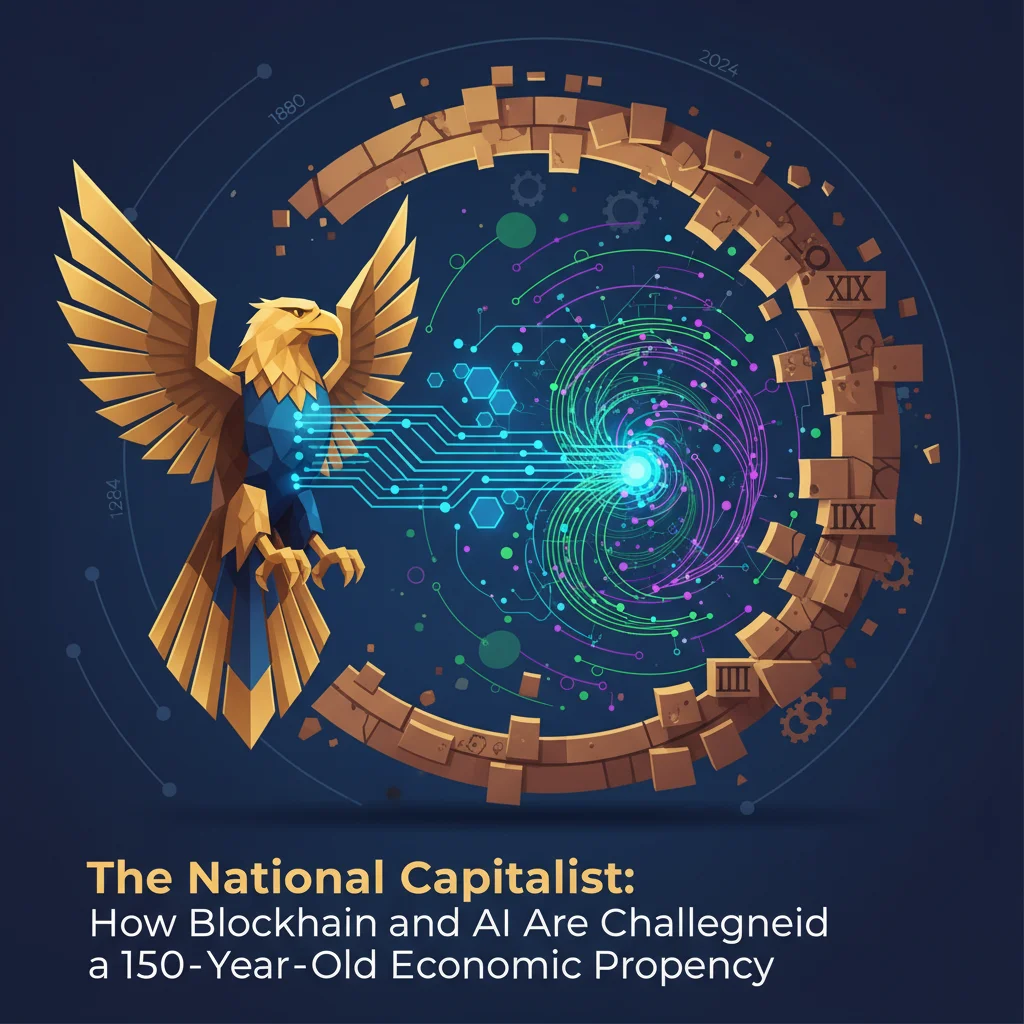
The National Capitalist: How Blockchain and AI Are Challenging a 150-Year-Old Economic Prophecy
The Echo of a 19th-Century Warning in Our Digital Age
In 1880, Friedrich Engels, the co-author of The Communist Manifesto, made a startling prediction. He argued that the modern state, in its final form, would inevitably become the “ideal personification of the total national capital.” It would absorb the means of production, not to liberate the people, but to become the ultimate capitalist, exploiting its citizens as a new, universal proletariat. For decades, this idea remained a cornerstone of Marxist economic theory, debated in academic circles but seemingly distant from the realities of Western market economies.
Yet, a recent letter to the Financial Times by Ivor Morgan resurrected this century-old prophecy, casting it in a striking new light. Morgan observed that Engels’s description of the state as the “national capitalist” eerily reflects our modern reality. From massive bank bailouts to sprawling sovereign wealth funds and unprecedented fiscal stimulus, the state’s role as a primary actor in the economy is undeniable. But Morgan’s letter posed a more profound question: If the state is indeed the national capitalist Engels foresaw, could modern technologies like fintech, blockchain, and AI be the “technical conditions” that finally provide a solution to this concentration of power?
This single question bridges a 150-year gap between industrial-age economic theory and the bleeding edge of financial technology. It forces us to confront whether the digital tools we are building today are merely reinforcing the old structures of power or creating the first real opportunity for a fundamental shift in the relationship between the state, the market, and the individual.
Engels’ Prophecy Realized: The Modern State as the Ultimate Investor
To understand the gravity of Morgan’s question, we must first appreciate the accuracy of Engels’s initial prediction. In his work, Socialism: Utopian and Scientific, Engels argued that as capitalism develops, the state is forced to take over ownership of productive forces. He wasn’t celebrating this; he was critiquing it. He wrote, “the more [the state] takes over productive forces, the more does it actually become the national capitalist, the more citizens does it exploit.” He concluded that this “state ownership…is not the solution of the conflict.”
How does this 19th-century theory map onto our 21st-century economy? The evidence is compelling:
- Sovereign Wealth Funds (SWFs): Nations now operate some of the largest investment funds on the planet. Norway’s Government Pension Fund Global, for example, owns on average 1.5% of every listed company in the world, with assets exceeding $1.5 trillion. These funds make the state a direct, and often controlling, shareholder in the global stock market.
- Post-Crisis Intervention: The 2008 financial crisis saw governments inject trillions into the banking system, effectively becoming the ultimate backstop for the “too big to fail” institutions. The COVID-19 pandemic triggered an even larger wave of state intervention, with governments directly funding businesses and individuals on a scale previously unimaginable in peacetime. In the U.S. alone, pandemic relief spending reached an estimated $4.6 trillion.
- State-Owned Enterprises (SOEs): While often associated with China, SOEs are significant players globally. They dominate sectors like energy, infrastructure, and telecommunications, blurring the lines between public service and corporate profit-seeking. They represent a direct manifestation of the state acting as a capitalist entity.
In this paradigm, citizens are not just taxpayers; they are the workforce and consumer base for a system in which the state is the dominant capital allocator. Monetary policy, particularly quantitative easing, can be viewed as a tool that benefits asset holders (including the state itself via its pension and social security holdings) at the expense of savers, a subtle form of exploitation. The “capitalist relation,” as Engels put it, “is not done away with. It is rather brought to a head.”
Market Tremors: Decoding the Financial Fallout of the New US Immigration Policy
The “Technical Conditions”: Can Technology Topple the National Capitalist?
If the state has brought the capitalist relation “to a head,” Engels prophesied it would then “topple over,” revealing “the technical conditions that form the elements of that solution.” This is where fintech, blockchain, and AI enter the stage. Are they the tools of a new economic paradigm or simply more efficient gears in the same capitalist machine?
Fintech and the Democratization of Banking
Financial technology (fintech) has directly challenged the traditional banking sector—a sector historically intertwined with and protected by the state. By lowering barriers to entry, fintech platforms for trading, lending, and payments have given individuals access to financial tools once reserved for the wealthy or well-connected. Peer-to-peer lending bypasses banks, and commission-free trading apps have brought millions of new participants into the stock market. However, this democratization is a double-edged sword. While empowering, these platforms are still centralized, regulated entities that operate within the state-controlled financial system. They may offer better user experiences, but they do not fundamentally alter the power structure.
Blockchain: The Decentralized Rebellion
Blockchain technology represents a far more radical departure. At its core, it is a technology for creating trust and consensus without a central authority. This directly confronts the state’s traditional monopoly over two critical functions: money and ledgers (the official record of who owns what).
Consider the implications of this shift from a centralized to a decentralized model:
| Function | Centralized System (The State’s Model) | Decentralized System (The Blockchain Model) |
|---|---|---|
| Currency Issuance | Controlled by a central bank; subject to monetary policy and inflation. | Governed by a transparent, programmatic algorithm (e.g., Bitcoin’s 21 million cap). |
| Transaction Validation | Requires trusted intermediaries like banks and payment processors. | Validated by a distributed network of computers; no single point of failure. |
| Asset Ownership | Recorded in centralized databases (land registries, bank accounts); can be frozen or seized. | Recorded on an immutable public ledger; controlled by the user’s private key (self-custody). |
| Governance | Hierarchical and opaque; decisions made by appointed officials. | Often community-driven through DAOs (Decentralized Autonomous Organizations). |
Cryptocurrencies like Bitcoin offer a non-sovereign store of value and medium of exchange. Decentralized Finance (DeFi) aims to rebuild the entire financial system—lending, borrowing, trading—on open, permissionless protocols. In theory, this is the most direct technological challenge to the “national capitalist” ever conceived. It creates parallel financial rails that the state cannot easily control or manipulate.
The Investor's Lexicon: Decoding the Puzzles of the Modern Economy
Artificial Intelligence: The Ultimate Tool of Control or Liberation?
AI is the wildcard. In the hands of the state, AI is a tool of unparalleled efficiency for surveillance and control. It can be used to monitor transactions, analyze economic behavior, and implement highly targeted policies like Central Bank Digital Currencies (CBDCs), which could allow for programmable money that the state can control directly. This represents the pinnacle of the national capitalist’s power—the ability to optimize economic exploitation with perfect information.
Conversely, in the hands of the individual, AI can be a powerful equalizer. AI-driven trading algorithms can level the playing field between retail investors and Wall Street institutions. AI can provide sophisticated financial planning to the masses, a service once exclusive to high-net-worth individuals. It can automate businesses and empower entrepreneurs, creating new vectors for wealth creation outside of traditional corporate or state structures.
Implications for Investors and Business Leaders in a Shifting Economy
This theoretical clash has profound, real-world consequences for finance professionals, investors, and business leaders. Navigating this new landscape requires a deep understanding of the competing forces at play.
For investors, the rise of a parallel, decentralized financial system presents both immense opportunity and significant risk. Allocating a portion of a portfolio to digital assets like Bitcoin can be seen as a hedge against the debasement of fiat currencies by the “national capitalist.” The growth of the entire digital asset economy offers a new frontier for venture-style returns. However, the regulatory response from the state remains the single greatest risk factor in the crypto space, making a keen understanding of policy essential for successful investing.
For business leaders, the imperative is to adapt or be left behind. Financial technology is no longer a niche; it is the core infrastructure of the modern economy. Businesses must integrate digital payments, explore the efficiencies of blockchain for supply chain management, and ethically leverage AI to remain competitive. Furthermore, they must develop strategies for operating in an economic environment where the state is an increasingly active participant, competitor, and regulator. The lines between public and private sectors will continue to blur, demanding new models of corporate governance and public affairs.
Decoding the Market: How to Solve the Global Economy's Most Complex Puzzle
Conclusion: The Unwritten Chapter
Friedrich Engels predicted a tipping point where the state’s role as the ultimate capitalist would become untenable. Ivor Morgan’s letter compellingly asks if we have finally reached that moment, with technology serving as the catalyst for the next stage of economic evolution. The answer is far from certain. Technology is not a destiny; it is a tool. Blockchain, AI, and fintech can be architected to create open, free, and decentralized systems, or they can be co-opted to build a more efficient and pervasive system of centralized control.
What is clear is that we are living through the conflict Engels described. The tension between the sovereign individual and the “national capitalist” state is no longer just a philosophical debate—it is a technological and economic reality. The “solution” he hinted at is not a predetermined outcome but a choice. It is a choice being made today in the code we write, the platforms we build, the assets we invest in, and the policies we support. The final chapter of this 150-year-old story is still being written.

Related Posts

The Unexpected Disruptor: How a Local Council’s Funeral Service Signals a Tectonic Shift in a $20 Billion Industry

Solving the Global Economy: Why Modern Finance is the Ultimate Crossword Puzzle