The Connoisseur’s Edge: What the Art World Teaches Investors About AI’s Limits
In the relentless march of technological progress, Artificial Intelligence has emerged as the definitive force reshaping industries. From banking to biotech, algorithms are optimizing processes, predicting outcomes, and generating efficiencies at a scale previously unimaginable. In the world of finance, AI is the new titan, powering high-frequency trading platforms, sophisticated risk models, and the burgeoning fintech revolution. The conventional wisdom is clear: data is the new oil, and AI is the ultimate refinery. But is this the whole picture?
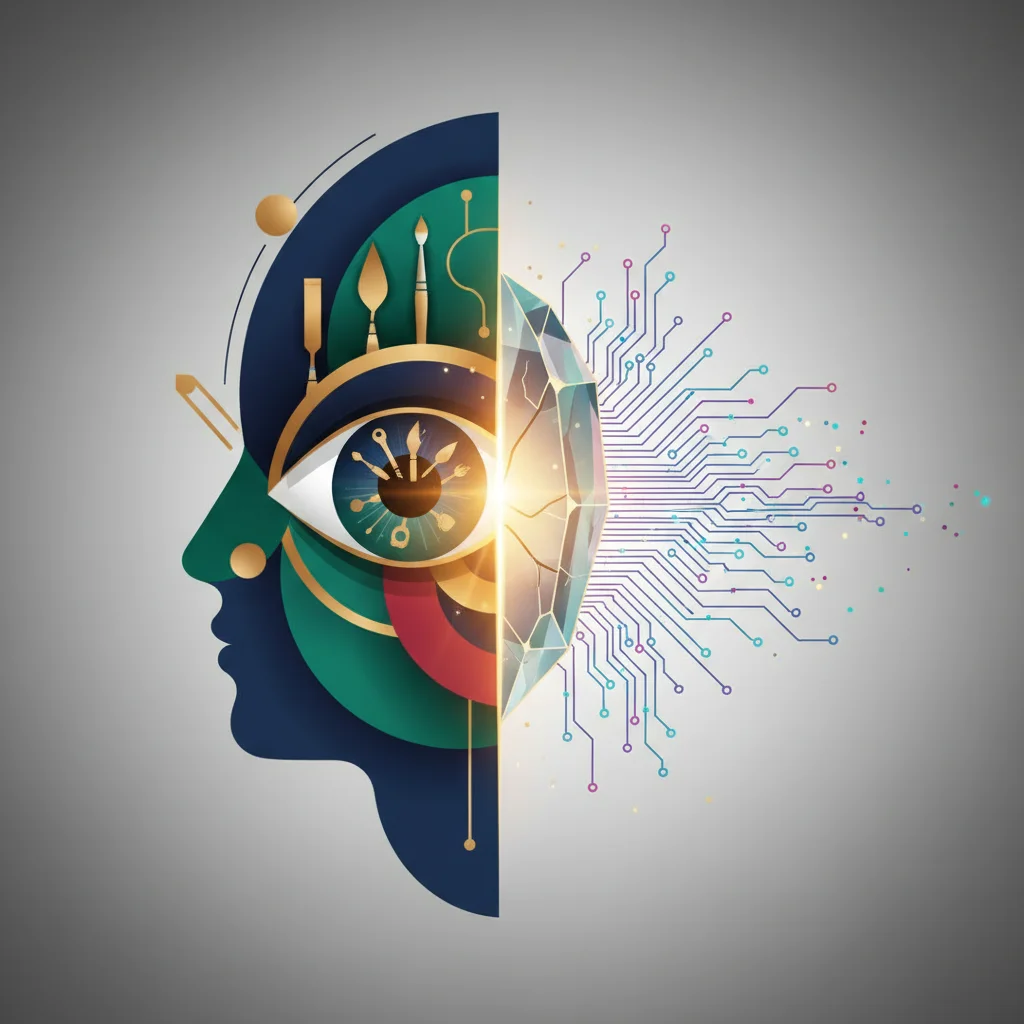
A recent letter to the Financial Times by Yasuyuki Ichikawa offers a poignant and unexpectedly profound counterpoint. In his piece, titled “AI versus art connoisseur — there’s really no contest,” Ichikawa argues that while an AI can analyze data points like stock prices, it can never replicate the “spiritual dialogue” a human expert has with a work of art. It cannot grasp the emotion, the historical context, or the sublime, intangible quality that defines great art. This observation, seemingly confined to the gilded halls of auction houses, holds a crucial lesson for every investor, trader, and business leader navigating the modern economy. It forces us to ask a critical question: In our rush to quantify everything, what invaluable human qualities are we at risk of overlooking?
This article explores that very question. We will delve into the art connoisseur’s critique to understand the inherent limitations of AI, then contrast it with the technology’s undeniable power in the quantitative realms of finance and the stock market. Ultimately, we will argue that the most successful professionals of the future will not be those who blindly trust the algorithm, but those who cultivate a “connoisseur’s edge”—blending AI’s analytical prowess with uniquely human intuition and wisdom.
The Connoisseur’s Critique: Why AI Can’t Feel a Masterpiece
To understand Ichikawa’s point, one must first appreciate what a true art connoisseur does. It is a discipline far removed from simply running an image through a database to check for stylistic markers or pigment composition. A connoisseur engages with a piece on multiple levels: historical, emotional, and technical. They understand the artist’s life, the political climate of the era, the provenance (the history of the artwork’s ownership), and the subtle narrative woven into the brushstrokes. This deep, contextual understanding is what allows them to differentiate a master’s work from a clever forgery and, more importantly, to articulate why a piece is significant.
The global art market, which reached an estimated value of $67.8 billion in 2022 according to the Art Basel and UBS Global Art Market Report, is not built on objective data alone. It thrives on narrative, scarcity, prestige, and collective human belief. An AI can analyze auction price histories and identify patterns, but it cannot feel the awe of standing before a Rothko, understand the revolutionary defiance in a piece of Dadaist art, or grasp the cultural significance that drives a piece’s value into the stratosphere. This is the domain of “qualia”—the subjective, conscious experience of seeing, feeling, and understanding. AI, for all its power, does not have qualia. It processes, but it does not experience.
This distinction is not merely philosophical; it has direct implications for any field where value is not purely transactional. The value of a brand, the strength of a corporate culture, or the long-term potential of a visionary founder are all concepts that, like art, possess a significant intangible dimension that algorithms struggle to price.
Market Tremors: Decoding the Financial Fallout of the New US Immigration Policy
The Quant’s Paradise: Where AI Dominates the Financial Landscape
If the art world represents the limits of AI, the world of modern finance represents its triumphant core competency. Here, in the realm of the stock market, banking, and economics, data reigns supreme. The financial markets generate an astronomical amount of quantitative data every second—price movements, trading volumes, economic indicators, and corporate earnings reports. This is the perfect environment for AI and machine learning to flourish.
The impact of financial technology, or fintech, has been revolutionary. AI-driven systems now execute a vast majority of trades on the world’s stock exchanges. Consider the following applications:
- Algorithmic & High-Frequency Trading (HFT): AI algorithms can analyze market data and execute millions of orders in fractions of a second, exploiting tiny price discrepancies that are invisible to the human eye.
- Risk Management: Banks and investment firms use sophisticated AI models to assess credit risk, detect fraudulent transactions in real-time, and stress-test their portfolios against countless potential economic scenarios.
- Predictive Analytics: Machine learning models are now used to forecast everything from GDP growth and inflation to the future performance of individual stocks, giving investors an analytical edge. A 2023 McKinsey global survey found that AI adoption has more than doubled in the financial services sector since 2018, with firms reporting significant revenue increases and cost decreases from its use.
To illustrate the stark contrast in how human and artificial intelligence are best applied, consider the following breakdown:
| Domain | Key Strengths of Human Expertise | Key Strengths of AI | Optimal Approach |
|---|---|---|---|
| Art Valuation | Contextual understanding, emotional resonance, narrative appreciation, authenticity judgment. | Analysis of historical auction data, artist market trends, image recognition for style. | AI for data analysis, human for final judgment on quality and significance. |
| Stock Market Trading | Long-term strategic vision, understanding of geopolitical shifts, qualitative assessment of management. | High-speed data processing, pattern recognition, emotionless execution, micro-second arbitrage. | Human sets the strategy; AI executes and optimizes trades at scale. |
| Credit Scoring (Banking) | Understanding unique personal circumstances, character assessment in business loans. | Massive data analysis of financial history, fraud detection, unbiased statistical modeling. | AI provides a baseline score; human underwriters review borderline or complex cases. |
The Art of Financial Connoisseurship: Investing Beyond the Numbers
The ultimate lesson from the art world is that even in the most data-driven fields, a qualitative, connoisseur-like perspective remains a powerful competitive advantage. The best investors have always understood this. Warren Buffett’s legendary success is built not just on analyzing balance sheets, but on a deep understanding of a company’s “economic moat,” the quality of its leadership, and its long-term brand value—factors that are notoriously difficult to quantify.
Venture capital is another prime example. While data on market size and growth is essential, the final investment decision often hinges on a subjective judgment of the founding team’s passion, resilience, and vision. This is financial connoisseurship in action.
This principle extends to emerging technologies like blockchain. On the surface, blockchain is a purely technical, data-centric system. Yet its fundamental value proposition is rooted in a deeply human concept: trust. Understanding why decentralized, trustless systems are revolutionary requires more than economic modeling; it requires a grasp of history, sociology, and human behavior. An AI can track the price of Bitcoin, but a human connoisseur can better articulate why it was created in the wake of the 2008 financial crisis and what its existence signifies for the future of the economy and banking.
Cosmic Rays and Market Waves: The Financial Fallout of Airbus's Solar Radiation Warning
Conclusion: Your Invaluable Edge in the Age of AI
The eloquent critique from the art world serves as a vital reminder for the world of finance and business. While we should absolutely embrace AI as a transformative tool for analysis, trading, and efficiency, we must not devalue the uniquely human skills that create lasting value. The ability to understand context, to craft a narrative, to judge character, and to make intuitive leaps based on experience are not obsolete functions; they are the premium skills of the 21st-century economy.
The future of successful investing and leadership will not belong to the machines alone, nor to the Luddites who reject them. It will belong to the financial connoisseurs—those who can stand in front of a complex market, a new technology, or a critical business decision and, like the art expert before a masterpiece, see beyond the surface data. They will use AI to analyze the canvas, the pigments, and the frame, but they will rely on their own cultivated wisdom to understand the art.

Related Posts
Market Relief: How a Diplomatic Handshake Averted a Transatlantic Trade War and Ignited a Stock Rally
Anatomy of a Rally: How a Diplomatic Handshake Averted a Trade War and Ignited the Stock Market