Beyond the Map: How Wayve’s AI Is Learning to Conquer London’s Chaos
The Un-drivable City and the AI That Dares to Try
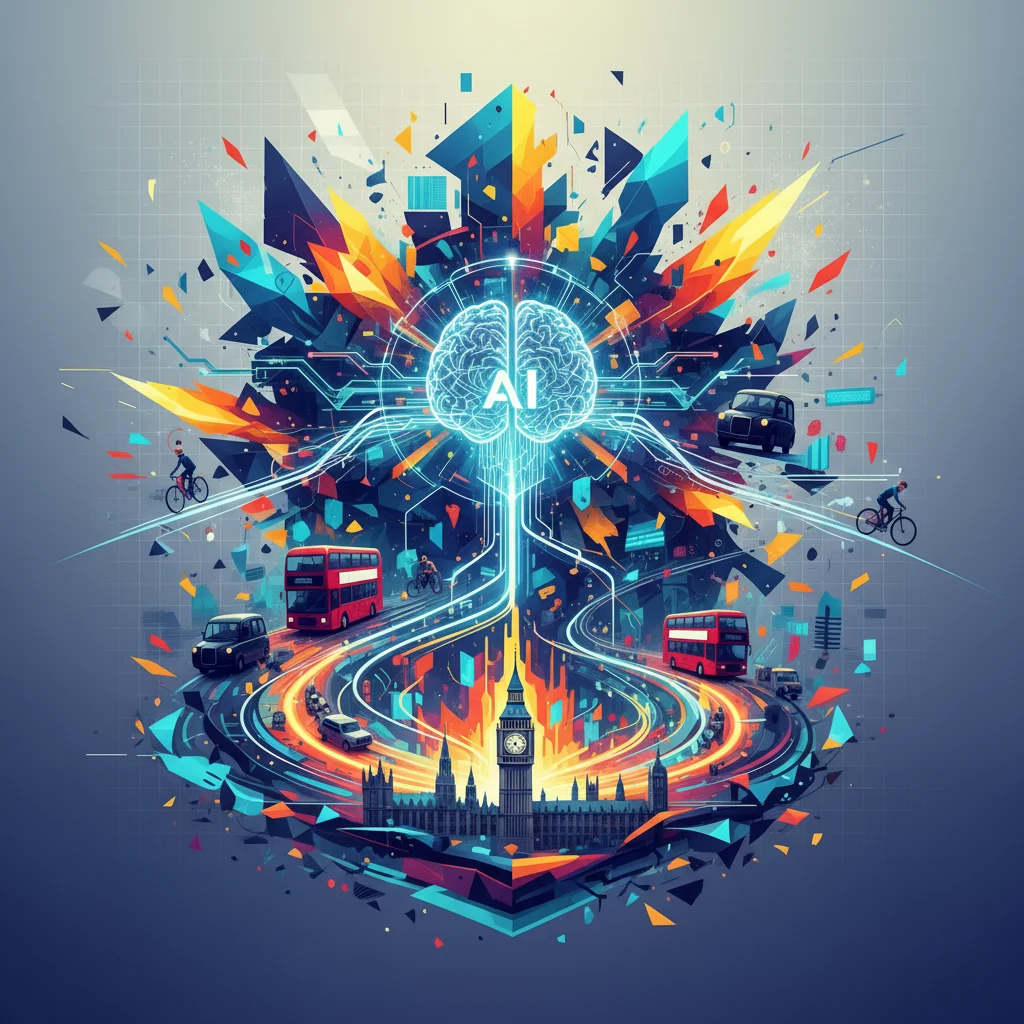
Picture this: you’re navigating Parliament Square in London. Double-decker buses lurch into your lane, cyclists weave through traffic with reckless abandon, and pedestrians step into the road, heads buried in their phones. It’s a symphony of organized chaos, a place where human intuition, hyper-awareness, and a bit of aggressive audacity are the only things that get you from A to B. Now, imagine teaching a machine to do it.
For years, the dream of the self-driving city has felt like a distant, sci-fi fantasy, particularly in ancient, tangled urban environments like London. The dominant approach, pioneered by giants like Google’s Waymo and GM’s Cruise, has been one of meticulous control. These systems rely on ultra-high-definition 3D maps, LiDAR sensors, and millions of lines of hand-written rules—a kind of digital “on-rails” experience. But what happens when the real world, in all its messy glory, goes off-script?
Enter Wayve, a British startup with a radically different philosophy. Led by CEO Alex Kendall, Wayve is betting that the only way to build a car that drives like a human is to teach it like a human. Forget the rigid maps and pre-programmed rules. Wayve is building an AI that learns from watching, experiencing, and adapting. It’s a bold gamble that could either redefine the future of automation or become a fascinating footnote in the history of artificial intelligence. Based on a recent test drive through London’s toughest streets, it’s a gamble that’s starting to look seriously compelling.
AI 1.0 vs. AI 2.0: A Tale of Two Philosophies
To understand what makes Wayve so different, you have to appreciate the fundamental schism in the world of autonomous driving. The industry has been dominated by what Alex Kendall calls the “AI 1.0” or “HD mapping” approach.
Think of it like this: an AI 1.0 car is like a tourist with an incredibly detailed, but static, guidebook. It knows every single street, traffic light, and curb with millimeter precision. It follows a pre-defined set of “if-this-then-that” rules. This works beautifully… until a road is closed for construction, a new roundabout appears, or a flock of pigeons decides to hold a meeting in the middle of the road. The system is brittle; it struggles with novelty because it can’t truly generalize its knowledge.
Wayve is pioneering the “AI 2.0” or “embodied AI” approach. This is less like a tourist with a guidebook and more like a student driver with a brain. It uses a suite of cameras to see the world and an end-to-end deep learning model to process that visual data. Instead of following explicit rules, it learns correlations and patterns from vast amounts of driving data. It learns what a cyclist *might* do, how a bus *tends* to move, and what a green light *implies*. It’s a system built on learning and prediction, not just rules and maps.
Here’s a breakdown of the two competing approaches:
| Feature | The “AI 1.0” Approach (e.g., Waymo, Cruise) | Wayve’s “AI 2.0” Approach |
|---|---|---|
| Core Technology | LiDAR, HD Maps, RADAR, Hand-coded Rules | Cameras, End-to-End Deep Learning Neural Network |
| Learning Method | Data annotation and explicit programming for edge cases | Observational learning from vast video data (like a “GPT for Driving”) |
| Scalability | Slow and expensive; requires meticulously mapping every new city | Potentially rapid and global; the system can generalize to new, unseen roads |
| Strengths | High precision and reliability in known environments | Adaptability, lower hardware cost, better at handling novel situations (“edge cases”) |
| Weaknesses | Brittle, struggles with the “long tail” of unexpected events | “Black box” nature can be harder to validate; requires immense data and compute power |
This isn’t just a technical debate; it’s a philosophical one about the nature of intelligence and learning. The AI 1.0 world believes you can codify the world into a set of logical rules. Wayve believes true intelligence must be learned, messy data and all.
The 10,000-Year Clock: What Jeff Bezos's Epic Project Teaches Us About Building Software That Lasts
Building a “GPT for Driving”
So, how does it actually work? Kendall describes Wayve’s core software as a “GPT for driving.” Just as large language models like ChatGPT ingest the entire internet to learn the patterns of language, Wayve’s model ingests millions of miles of driving data to learn the patterns of the road. This deep learning model, a form of advanced machine learning, takes in raw video from the cameras and outputs direct driving commands: accelerate, brake, turn left, turn right.
There is no intermediate step where the AI identifies “that is a pedestrian” and then consults a rulebook on “how to act around pedestrians.” Instead, it learns from observing countless examples of how skilled human drivers navigate around people, bikes, and buses. It’s a more holistic, intuitive form of intelligence that aims to replicate the subconscious decision-making we humans do every second behind the wheel.
During a demonstration ride with the Financial Times, a Wayve-equipped Jaguar I-Pace navigated some of London’s most notorious spots, including a six-lane roundabout at Hyde Park Corner. The system wasn’t perfect; the safety driver had to intervene twice in 45 minutes. But perfection isn’t the point at this stage. The marvel is that a system with no pre-built maps of the area could handle that level of complexity at all, making nuanced decisions like nudging into traffic and yielding to aggressive drivers.
AI vs. Antitrust: Why Getty's Standoff with Regulators is a Warning for All of Tech
However, this new paradigm comes with its own set of profound challenges. The “black box” nature of deep learning models means even Wayve’s engineers can’t always explain *exactly* why the AI made a specific decision. This raises critical questions for safety, regulation, and cybersecurity. How do you certify a system whose reasoning is emergent rather than explicitly programmed? How do you protect a learning system from being “poisoned” with bad data? The failure of Cruise in San Francisco, which stemmed from its inability to handle an edge case, has rightly made regulators and the public wary. Wayve’s success will depend not just on its technological prowess, but on its ability to build a new framework for trust and validation around this powerful, less-interpretable form of AI.
The Business Model: Selling Intelligence as a Service
Wayve isn’t planning to build its own fleet of robotaxis. Instead, it’s pursuing a far more scalable and capital-efficient business model: licensing its intelligence. The company sees itself as a B2B SaaS (Software as a Service) provider for the automotive industry. Carmakers can integrate Wayve’s AI “brain” into their vehicles, effectively buying a sophisticated driver-assist system or a fully autonomous capability that works everywhere, on day one.
This model is incredibly attractive. It allows Wayve to focus on what it does best—AI and software development—while leveraging the massive manufacturing and distribution scale of established automotive giants. It also taps into the power of the cloud, as data from every car running their software can be used to continuously train and improve the central AI model, creating a powerful network effect.
Investors are clearly buying into this vision. In 2022, Wayve raised a formidable $200 million in a Series B funding round, with backers including tech heavyweights like Microsoft and Virgin. This financial backing provides the immense resources needed for the large-scale data collection and computational power that this machine learning approach demands.
This strategy of selling the core intelligence is a powerful form of innovation, separating the “mind” of the car from its body. It allows for faster iteration and deployment, turning the car into a platform that gets smarter over time with over-the-air updates—a model famously pioneered by Tesla, another proponent of a vision-based AI driving system.
€3 Billion Bird: How Quantum Systems' AI Drones are Redefining European Tech and Defense
The Road Ahead: Can Learning Beat Programming?
The journey to full autonomy is a marathon, not a sprint. While Wayve’s progress is undeniably impressive, the road ahead is filled with challenges. Scaling data collection, ensuring the system is robust against corner cases, and navigating the complex web of global automotive regulations are all monumental tasks.
Yet, Wayve’s core thesis remains powerful. By building an AI that learns from the world as it is, rather than a pre-programmed version of what we think it should be, they are creating a system that is inherently more adaptable and scalable. As Alex Kendall puts it, their goal is to build an AI that can drive “anywhere, in any city.” It’s a vision that moves beyond the geofenced, meticulously mapped robotaxi services of today and towards a future of truly universal autonomous driving.
Can Wayve make London a self-driving city? Perhaps not tomorrow. But by teaching its AI to handle the beautiful chaos of London’s streets, it might just be building an AI that can eventually drive anywhere on Earth. And that is a far more transformative destination.