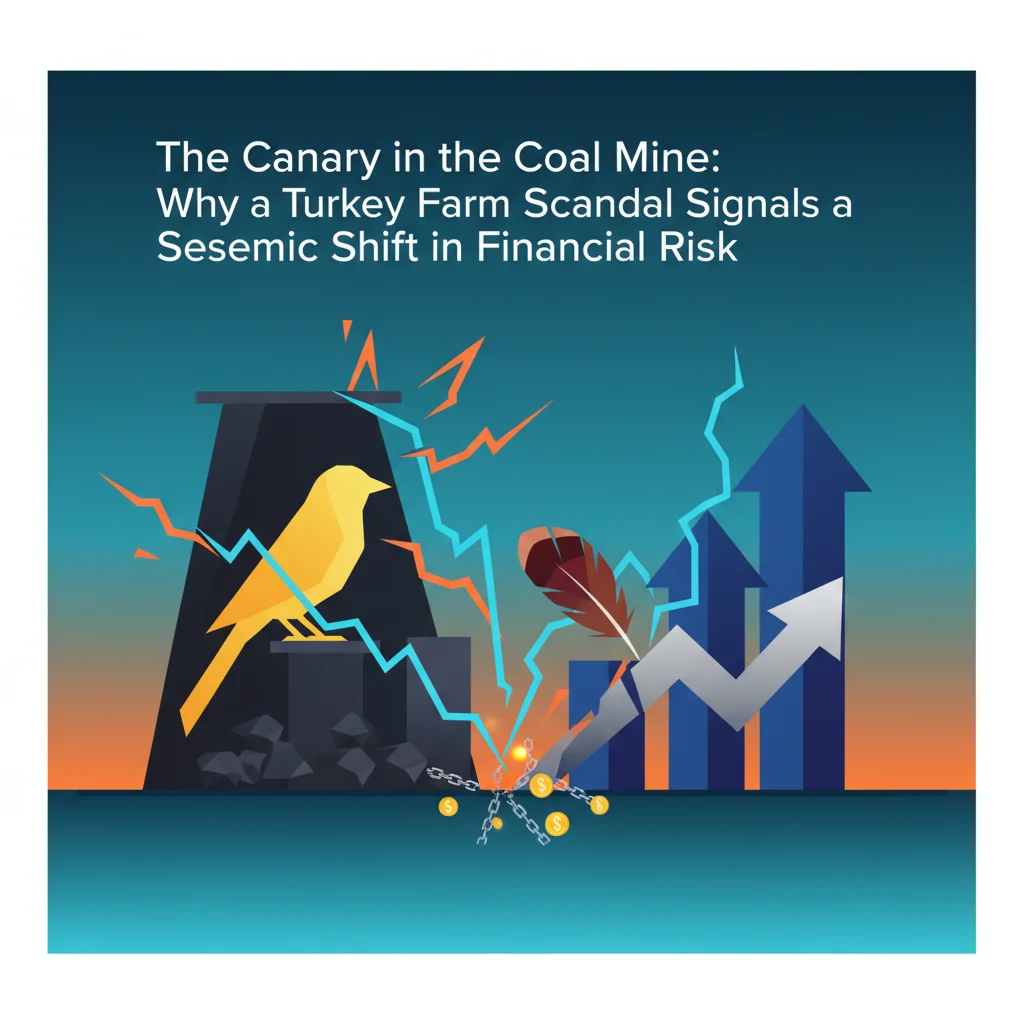
The Canary in the Coal Mine: Why a Turkey Farm Scandal Signals a Seismic Shift in Financial Risk
On the surface, it’s a story that seems worlds away from the high-stakes environment of Wall Street and global finance. A BBC report has revealed that a UK-based turkey breeding farm, a supplier to prestigious luxury retailers, is under investigation for serious animal welfare and biosecurity lapses, leading to the suspension of several workers. For many, this is a localized issue—a matter for animal rights activists and food industry regulators. But for the astute investor, the C-suite executive, and the modern finance professional, this incident is much more. It’s a stark and potent symbol of a new class of risk that can no longer be ignored: the profound financial impact of Environmental, Social, and Governance (ESG) failures.
In today’s hyper-connected economy, a scandal on a remote farm can trigger a cascade of value destruction that ripples through supply chains, erodes brand equity, and ultimately, punishes a company’s stock market valuation. The traditional models of financial analysis, which focus purely on balance sheets and income statements, are proving dangerously incomplete. This single event serves as a powerful case study, demonstrating that the most significant threats to modern enterprise and investment portfolios often lie far beyond the numbers, hidden in the operational and ethical fabric of a company’s network. Understanding this shift is no longer optional; it is fundamental to successful investing, robust corporate strategy, and the future of financial technology.
Deconstructing the Crisis: More Than Just a Farm
The initial report details allegations at a breeding site owned by Aviagen Turkeys, a major industry player. The concerns are twofold: animal welfare and biosecurity. While the former captures public attention and outrage, the latter poses a direct and catastrophic threat to the business itself. A biosecurity breach in a poultry operation can lead to the rapid spread of diseases like avian flu, potentially requiring the culling of entire flocks and halting production for months. For a company that supplies premium retailers, the fallout is immediate and severe.
However, the direct operational impact is only the first domino to fall. The true financial danger lies in the intangible assets that are suddenly at risk:
- Brand and Reputation: The farm supplies high-end stores, whose entire business model is built on a promise of quality, trust, and superiority. An association with animal cruelty or unsafe practices directly undermines this brand promise, risking customer boycotts and a long-term decline in brand loyalty.
- Supply Chain Integrity: For the retailers dependent on this supplier, the investigation creates immediate uncertainty. They must now scramble to secure their supply chain, potentially at a higher cost, and manage the public relations fallout of being associated with the scandal.
- Investor Confidence: News of operational malpractice and ethical lapses is a major red flag for the investment community. It signals a failure in governance and oversight—a core component of the “G” in ESG. According to a study by Morgan Stanley, companies with strong ESG practices often exhibit higher profitability and lower risk profiles, making them more attractive long-term investments. A scandal like this does the exact opposite, raising questions about management’s ability to control its operations and mitigate foreseeable risks.
This incident is a textbook example of how a seemingly isolated operational failure can metastasize into a full-blown crisis of confidence, impacting everything from consumer behavior to stock market performance.
A New Titan in the London Skyline: Why One Bank's Skyscraper is a Bold Bet on the Future of Finance
The ESG Imperative: Connecting Ethics to Economics
For decades, the worlds of finance and social responsibility were largely separate. Today, they are inextricably linked through the framework of ESG investing. The global market for ESG-focused assets is exploding, with projections suggesting it could reach $53 trillion by 2025, representing more than a third of all professionally managed assets. This isn’t just a trend; it’s a fundamental re-evaluation of what constitutes “value” and “risk.”
The turkey farm case highlights the “S” (Social) and “G” (Governance) pillars with brutal clarity:
- Social Risk: This encompasses a company’s relationships with its workforce, the communities in which it operates, and its customers. The animal welfare allegations fall squarely into this category, as they violate societal expectations of ethical treatment and corporate responsibility. For a consumer-facing brand, this is a direct threat to its social license to operate.
- Governance Risk: The failure to enforce biosecurity protocols and maintain ethical standards points to a breakdown in corporate governance. It raises critical questions: Were audits being conducted? Were internal controls effective? Did management foster a culture of compliance or one of corner-cutting? For investors, poor governance is one of the most significant predictors of future financial underperformance and scandal.
Investors are no longer just looking at price-to-earnings ratios; they are running sophisticated screens to identify companies with ESG vulnerabilities. A company with a supply chain tainted by ethical lapses is now considered a high-risk asset, regardless of its quarterly earnings. This shift forces a new level of accountability, transforming corporate ethics from a public relations exercise into a core component of financial strategy and risk management.
A New Paradigm for Risk Assessment
The incident forces us to compare the old way of thinking about risk with the new, integrated reality. The following table illustrates this evolution in risk perception, which is crucial for anyone involved in finance, trading, or corporate leadership.
The table below contrasts traditional financial risk analysis with a modern, ESG-integrated approach, highlighting how the perception of key business risks has evolved.
| Risk Category | Traditional Financial View | Modern ESG-Integrated View |
|---|---|---|
| Supply Chain | Focus on cost, logistics, and delivery times. Risk is a disruption in physical flow. | Focus on ethical sourcing, labor practices, environmental impact, and geopolitical stability. Risk includes reputational damage and consumer boycotts. |
| Operations | Measured by efficiency, output, and unit cost. Risk is equipment failure or downtime. | Measured by safety, compliance, and biosecurity. Risk includes regulatory fines, legal liability, and brand-tarnishing scandals. |
| Human Capital | Viewed as a cost center (salaries, benefits). Risk is high turnover or labor strikes. | Viewed as a core asset. Risk includes poor corporate culture, lack of diversity, and unethical behavior leading to internal and external crises. |
| Brand Value | An intangible asset on the balance sheet, influenced by marketing spend and market share. | A dynamic asset directly tied to corporate behavior, transparency, and social license to operate. Highly vulnerable to social media and activist campaigns. |
The UK Budget Unpacked: A Deep Dive into the Financial Winners and Losers
The C-Suite Playbook: From Reactive Damage Control to Proactive Resilience
So, how can business leaders and investors protect themselves from these emerging threats? The solution lies in shifting from a reactive posture to a proactive strategy built on transparency, technology, and rigorous due-diligence.
1. Radical Supply Chain Transparency: The era of “don’t ask, don’t tell” in supply chains is over. Companies must invest in deep, multi-tiered audits of their suppliers, going beyond simple contractual agreements to assess their ethical, environmental, and labor practices. This is where financial technology can play a transformative role. Emerging fintech platforms are using AI to monitor suppliers in real-time, while blockchain ledgers offer the potential for unalterable proof of provenance.
2. Integrating ESG into Core Financial Strategy: ESG can no longer be relegated to a corporate social responsibility department. It must be a core consideration in all major business decisions, from capital allocation and M&A to executive compensation. The Chief Financial Officer must now also be a Chief Risk Officer, with a deep understanding of how non-financial factors drive the bottom line. This integration is crucial for maintaining a favorable position on the stock market and attracting capital in an ESG-conscious economy.
3. Proactive Stakeholder Engagement: Companies must actively engage with investors, customers, and regulators about their ESG performance. This means transparent reporting, setting clear and measurable goals, and being accountable for shortcomings. In today’s economy, silence is often interpreted as guilt. Proactive communication can build a reservoir of goodwill that is invaluable during a crisis.
The €22 Mona Lisa: A Masterclass in Economics Behind the Louvre's 45% Price Hike
Conclusion: The New Bottom Line
The investigation at a single turkey farm is a microcosm of a much larger shift in the global economy. It demonstrates, with undeniable clarity, that a company’s value is no longer determined solely by its financial performance. It is equally dependent on its ethical conduct, its environmental stewardship, and its commitment to good governance.
For investors, the lesson is clear: due diligence must now extend far beyond the balance sheet. For business leaders, the message is a warning: the weakest link in your supply chain can become the biggest threat to your enterprise. As the worlds of finance, economics, and ethics continue to converge, the companies that thrive will be those that understand that building a resilient and profitable business is about more than just managing money—it’s about managing trust.

Related Posts
Cracks in Confidence: How a Nuclear Scandal Shakes Japan’s Economy and Investor Trust
The Politicization of the Portfolio: How State Interference Puts US Companies and Investors at Risk