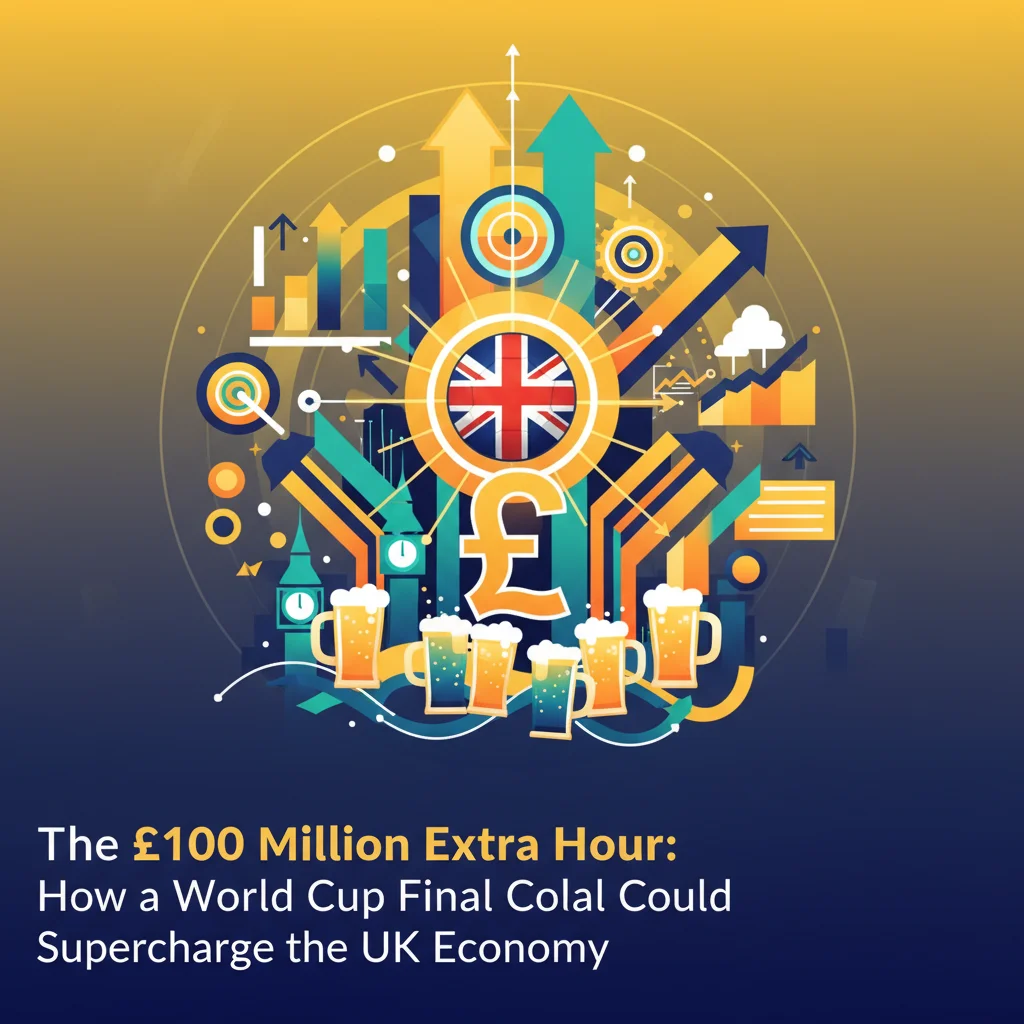
The £100 Million Extra Hour: How a World Cup Final Could Supercharge the UK Economy
A subtle yet potentially seismic shift in the UK’s economic landscape is on the horizon, disguised as a simple regulatory tweak. The government has revealed a plan that could see pub licensing hours extended to 1 a.m. across England and Wales if a home nation—England or Scotland—reaches the semi-finals or final of the upcoming men’s or women’s World Cup or European Championship. While on the surface this news appeals to football fans, for investors, finance professionals, and business leaders, it represents a fascinating case study in event-driven economics and a potential short-term injection of capital into the consumer economy.
This proposal, detailed in a Home Office consultation as reported by the BBC, is more than just an opportunity for a late-night celebratory pint. It’s a deliberate policy tool designed to leverage national sentiment to stimulate economic activity. By analyzing the potential cascading effects of this decision, we can uncover valuable insights into consumer behavior, sector-specific investment opportunities, and the intricate connections between national events and the broader financial markets.
The Direct Economic Multiplier: Beyond Beer and Pubs
The most immediate beneficiaries are, of course, the UK’s beleaguered hospitality sector. Pubs, bars, and breweries have faced a tumultuous period, navigating the aftershocks of a pandemic, soaring energy costs, and inflationary pressures on both supplies and consumer discretionary spending. An extra hour of trading during a peak-demand event like a World Cup final is not a trivial matter. According to the British Beer and Pub Association, major tournaments can result in the sale of an additional 30 million pints, generating a significant revenue uplift for the sector. Extending hours would amplify this effect substantially.
However, the financial impact extends far beyond the pub landlord’s cash register. This is a classic example of the economic multiplier effect in action. Consider the supply chain:
- Breweries & Distilleries: Increased demand necessitates higher production, benefiting both large-scale producers and the burgeoning craft beer market. Their performance on the stock market could see a temporary, positive flutter.
- Food Suppliers: Late-night trading means more orders for everything from snacks to full meals, a boon for wholesalers and local producers.
- Logistics & Transport: Getting the extra stock to thousands of venues requires a robust logistics network, benefiting delivery and haulage firms.
- Staffing & Employment: Venues will require more staff working longer hours, translating to increased wages which are then spent elsewhere in the economy.
This single policy change creates a ripple effect, channeling revenue through multiple interconnected industries. For an investor, this means looking beyond the obvious hospitality stocks and considering ancillary sectors that stand to gain from this concentrated burst of consumer spending. The Financial Puzzle: Decoding the Key Concepts Every Modern Investor Must Master
A Financial Technology Stress Test: The Unseen Winners
In the modern economy, every transaction is a data point, and every surge in activity is a stress test for the underlying financial infrastructure. This is where the world of fintech and financial technology plays a pivotal, albeit often invisible, role. An extra hour of trading during a World Cup final could mean millions of additional card, contactless, and mobile payments processed in a very short window.
The winners here are numerous:
- Payment Processors: Companies like Visa, Mastercard, and Worldpay will see a direct increase in transaction volume, which is how they generate revenue.
- Point-of-Sale (POS) System Providers: Modern POS systems are the digital backbone of hospitality. They not only process payments but also provide real-time data on sales, inventory, and customer behavior. This event would highlight the necessity of robust, cloud-based systems, driving adoption and upgrades. This data is invaluable for strategic business decisions and for analysts modeling consumer trends.
- Digital Banking & Neobanks: The ease of “buy now, pay later” (BNPL) services and instant mobile transfers facilitated by digital banks will be crucial for consumers managing their spending during a night out. The efficiency of the underlying banking infrastructure is key to a seamless consumer experience.
This event serves as a microcosm of the digital transformation of commerce. The ability to handle high-volume, low-value transactions swiftly and securely is a testament to the advancements in financial technology. For those investing in the fintech space, it’s a real-world demonstration of the sector’s essential role in the modern consumer economy.
Modeling the Potential Economic Impact
To quantify the potential benefits, we can model the estimated financial impact across key sectors. While precise figures are speculative until an event occurs, we can use historical data from similar events, such as the London 2012 Olympics or previous World Cups, to create a plausible forecast. A study by Lloyds TSB on the 2012 Olympics found a significant boost to retail and hospitality, an effect that is often replicated during major football tournaments (source). The following table provides a hypothetical breakdown of the economic contribution of extending pub hours for a single major final.
| Sector | Estimated Economic Uplift (Single Event) | Key Drivers |
|---|---|---|
| Hospitality (Pubs & Bars) | £80m – £120m | Increased footfall, extended trading hours, higher spend per head. |
| Food & Beverage Supply Chain | £30m – £45m | Increased orders from breweries, food wholesalers, and distributors. |
| Financial Technology & Payments | £5m – £8m | Increased transaction volume and processing fees. |
| Transport & Ride-Sharing | £10m – £15m | Higher demand for taxis, ride-sharing services, and public transport. |
| Retail (Supermarkets & Off-Licences) | £50m – £75m | Increased sales for at-home celebrations (data from Kantar shows this parallel effect). |
This data illustrates that the primary impact on the economy is concentrated in consumer-facing sectors, but the secondary effects are widespread. For those involved in economic forecasting and market analysis, these events provide rich data for understanding the dynamics of discretionary spending. Beyond the Ban: Unpacking the Financial Fallout of Australia's War on Social Media
The Investment Thesis: Trading on National Sentiment
From an investment perspective, how can one strategically approach this? This falls into the category of tactical, event-driven trading rather than long-term value investing. The market is likely to price in the potential for success as a tournament progresses. An astute investor or trader would monitor the performance of the home nations and look for opportunities in several areas:
- Hospitality & Brewery Stocks: The most direct play. Look for publicly traded pub chains (e.g., Mitchells & Butlers, Wetherspoons) and breweries. Their stock may see increased volatility and volume around key matches.
- Media & Advertising: A successful run for a home nation guarantees massive television audiences. This translates directly into higher advertising revenue for broadcasters like ITV.
- Betting Companies: Major tournaments are peak periods for betting companies like Flutter Entertainment and Entain. A deep run by a home team keeps casual punters engaged for longer.
- Fintech and Payment Processors: While the impact on a global giant like Visa would be minimal, it contributes to their overall quarterly performance and reinforces the investment case for the continued digitization of payments.
The risk, of course, is the unpredictable nature of sport. An early exit for the home nations would instantly deflate this economic balloon, potentially leading to losses for those who invested purely on the expectation of a deep tournament run. This is a high-risk, high-reward scenario that hinges entirely on sporting outcomes. Beyond the Flames: What a Hong Kong Tragedy Teaches Investors About 'Black Swan' Risks
Conclusion: A Micro-Policy with Macro-Economic Implications
The government’s proposal to extend pub licensing hours is a shrewd piece of economic policy wrapped in the flag of national pride. It demonstrates a clear understanding of how to leverage cultural moments to generate tangible economic benefits. For the finance professional, it serves as a powerful reminder that the drivers of the economy are not always found in central bank statements or fiscal policy documents. Sometimes, they’re found in the collective cheer of a nation watching a football match.
By analyzing this single decision through the lenses of economics, investing, and financial technology, we can see the deep, interconnected web of modern commerce. It highlights the resilience of the hospitality sector, the critical infrastructure provided by fintech, and the powerful influence of consumer sentiment on the broader stock market. While the outcome on the pitch remains uncertain, the economic game plan is clear: for a few crucial hours, a national celebration could provide a much-needed boost to the UK’s economic engine.

Related Posts
UK’s Fiscal Surprise: Decoding the December Dip in Government Borrowing and What It Means for Investors
UK’s Unexpected Fiscal Breather: Decoding the December Borrowing Drop and Its Impact on the Economy
