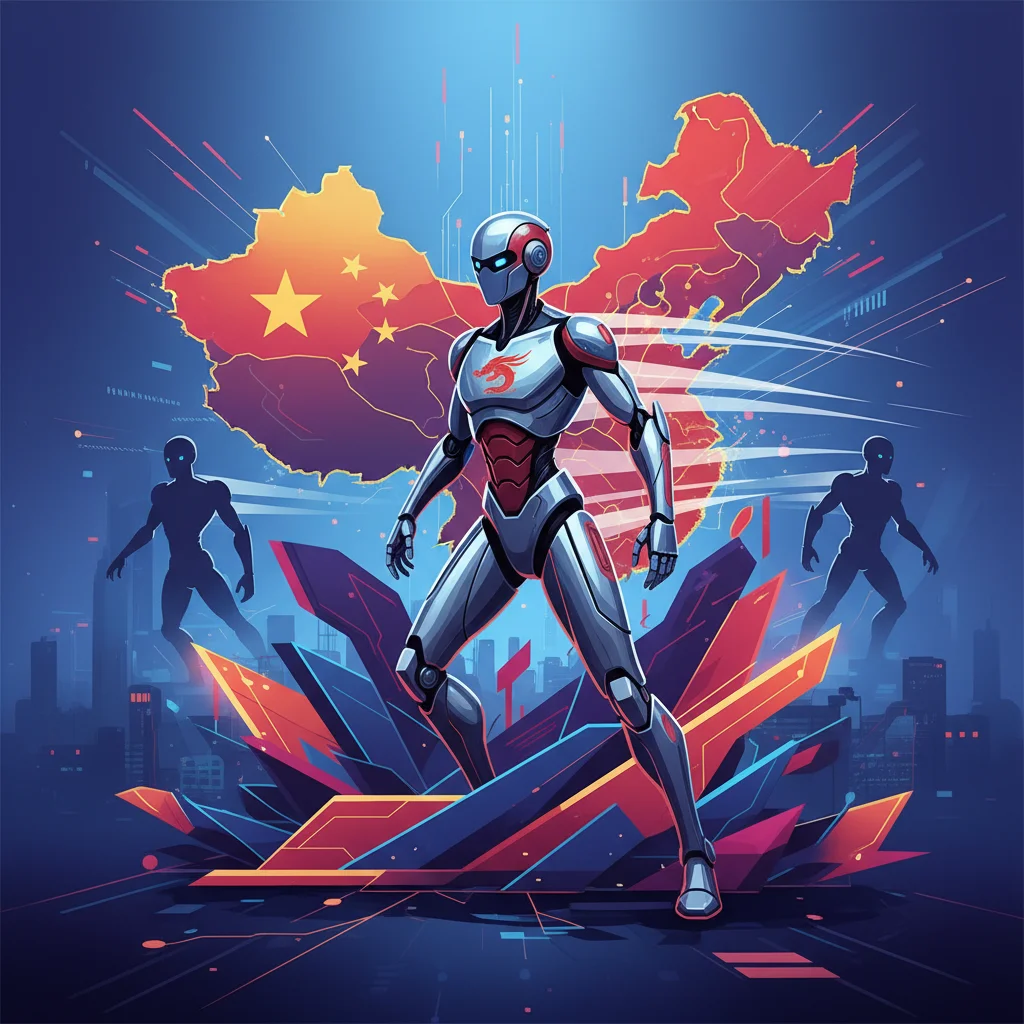
The AI Arms Race Goes Physical: Why China is Dominating the Humanoid Robot Revolution
If you’ve seen the recent video from Chinese startup Astribot, you know the world of robotics just had its “iPhone moment.” A humanoid robot, the S1, moves with a speed and fluidity that is frankly unsettling. It uncorks a wine bottle, carefully pours a glass, and even slices a cucumber with a chef’s knife—all at a pace that rivals, and in some cases surpasses, human speed. This isn’t a clunky, slow-moving prototype from a decade ago. This is something new.
For years, the conversation around advanced humanoid robots was dominated by American names like Boston Dynamics and, more recently, Tesla with its Optimus project. But while the West was showcasing impressive but often research-focused demos, a seismic shift was happening. China has quietly and methodically entered the race, and it’s not just participating—it’s aiming to take the baton and run away with it. This isn’t merely a competition over hardware; it’s a strategic, state-backed push to dominate the next frontier of automation, powered by cutting-edge artificial intelligence and machine learning.
The question is no longer *if* humanoids will become a part of our world, but who will build them, who will control the software that runs them, and what it means for the future of industry, society, and the global balance of power.
A “Minsky Moment” for Robotics
Economists use the term “Minsky moment” to describe the sudden collapse of asset values after a long period of growth. In technology, we’re seeing an inverse Minsky moment for robotics: a sudden, explosive surge in capabilities after decades of slow, incremental progress. For a long time, humanoid robots were clumsy, slow, and confined to university labs. Now, in the span of just a few months, we’ve seen:
- Figure AI’s robot holding a conversation and performing tasks based on verbal commands, powered by OpenAI’s models.
- Boston Dynamics retiring its hydraulic Atlas and unveiling a sleeker, fully electric version with uncanny flexibility.
- Tesla showcasing Optimus bots folding laundry and performing factory tasks.
- And now, a flood of Chinese startups like Astribot and Unitree demonstrating breathtaking speed and dexterity.
What changed? The convergence of two key technologies: advanced mechanics and generative AI. The physical “bodies” have become more sophisticated, but the real revolution is in the “brain.” The same large language models (LLMs) that power ChatGPT are giving these robots a new ability to understand the world, interpret commands, and learn new skills. This fusion of AI and hardware is the catalyst for the current explosion in innovation.
China’s Strategic Gambit: A Top-Down Revolution
While Western development has been largely driven by private companies and venture capital, China’s approach is a coordinated national strategy. In late 2023, China’s Ministry of Industry and Information Technology (MIIT) unveiled an ambitious plan to achieve mass production of humanoid robots by 2025 and establish a world-leading industry by 2027.
This isn’t just a paper plan. It’s a full-court press involving subsidies, research grants, and the mobilization of the country’s formidable manufacturing and supply chain ecosystems. Beijing sees humanoids as a solution to multiple strategic challenges:
- Demographic Shifts: A rapidly aging population and shrinking workforce threaten China’s manufacturing dominance. Robots offer a way to maintain productivity.
- Economic Upgrading: Moving from low-cost manufacturing to high-tech, high-value production requires sophisticated automation.
- Geopolitical Ambition: Leading the robotics revolution is a key pillar of China’s goal to become the world’s preeminent technological power.
The results are already visible. Companies like Unitree, initially known for their dog-like quadruped robots, have pivoted to humanoids with astonishing speed. Their H1 robot is being touted as one of the fastest in the world. Similarly, Astribot, a spinoff from a company that worked on Tencent’s robotics lab, claims its S1 model can perform movements at a maximum speed of 10 meters per second and handle a payload of 10kg per arm (source). These aren’t just one-off prototypes; they are products designed for manufacturability and scale.
Geopolitical Chess: The Great Offshore Migration of Chinese AI
To understand the different philosophies driving this race, it’s helpful to compare the two ecosystems side-by-side.
| Feature | The US / Western Approach | The Chinese Approach |
|---|---|---|
| Key Players | Tesla, Boston Dynamics, Figure AI, Agility Robotics | Unitree, Astribot, Fourier Intelligence, multiple state-backed startups |
| Driving Force | Private sector, venture capital, corporate R&D | State-directed industrial policy (MIIT), national champions |
| Core Strategy | Breakthrough “moonshot” projects, focus on general intelligence (AGI) | Rapid iteration, supply chain integration, focus on near-term industrial use cases |
| Potential Strengths | Pioneering AI research, strong software ecosystem, established tech giants | Unmatched manufacturing scale, government support, speed of execution |
| Potential Weaknesses | Slower path to commercialization, high R&D costs | Potentially lagging in foundational AI models, risk of top-down miscalculations |
Think of the robot as the ultimate IoT device. The hardware is just the edge component. The real work—learning, processing, decision-making—will increasingly happen via sophisticated, cloud-based AI platforms. We’re talking about a SaaS (Software-as-a-Service) model for robotics, where a physical robot’s capabilities can be upgraded overnight with a software update pushed from a central server.
This raises critical questions. Who owns the “Robotics OS”? Will it be an open ecosystem like Android or a closed one like Apple’s iOS? And most importantly, what about cybersecurity? When a robot can lift hundreds of pounds and operate dangerous machinery, a security breach isn’t just about data theft; it’s a matter of physical safety. Securing the entire stack, from the onboard firmware to the cloud-based AI, will be one of the single greatest challenges for this emerging industry. The country that masters this software and security ecosystem will lead, regardless of who can build the cheapest metal body.
The Software Soul of the New Machine
Ultimately, a humanoid robot is a physical avatar for an AI. Without advanced programming and intelligence, it’s just a very expensive mannequin. The recent breakthroughs are a direct result of advances in several areas of AI and machine learning:
- Reinforcement Learning: Robots can learn complex tasks through trial and error in simulated environments, then transfer that knowledge to the real world. This dramatically speeds up the development process.
- Computer Vision: The ability to see and interpret the world is fundamental. Modern vision systems can identify objects, track motion, and build 3D maps of their surroundings in real-time.
- Large Language Models (LLMs): This is the game-changer. By integrating LLMs, developers can instruct robots using natural language (“Please pick up that apple and put it in the basket”) instead of writing thousands of lines of code for every single action. The AI can break down the command into a sequence of physical movements.
This is where the competition gets interesting. While the US currently leads in developing foundational AI models (think OpenAI, Google, Anthropic), China is pouring immense resources into closing that gap. The race to build the most capable humanoid robot is, therefore, inextricably linked to the broader race for AI supremacy. The hardware provides the body, but the AI provides the mind, and you can’t have a truly useful robot without both operating at an elite level. As one expert in the FT article notes, this is a competition where “the brain is more important than the brawn” (source).
From Publisher to Predictor: How Relx Used AI to Turn a Dying Business into a Data Empire
Beyond the Factory: The Great Integration Challenge
The initial target market for these robots is clear: logistics, manufacturing, and hazardous environments. They can perform repetitive, physically demanding, or dangerous jobs currently done by humans. This is the low-hanging fruit and the primary driver of the massive investment we’re seeing.
But the long-term vision, for both Western and Chinese companies, extends far beyond the factory floor. The ultimate goal is the “general purpose” humanoid robot—a machine that can operate in human-centric environments like offices, hospitals, and homes. This is where the challenge becomes less about engineering and more about sociology and psychology.
Will we be comfortable with autonomous machines that look and move like us walking around our homes? The “uncanny valley”—the sense of unease people feel when a robot looks almost, but not quite, human—is a real psychological barrier. How do we ensure safety, privacy, and ethical behavior? If a robot makes a mistake that causes harm, who is liable? The owner? The manufacturer? The programmer who wrote the AI model?
These are no longer theoretical questions for science fiction authors. They are practical, pressing issues that developers, entrepreneurs, and policymakers must grapple with *now*. The delightful faith we have in these automatons, as the original article puts it, raises profound questions about how they will truly integrate into our society.
From iPhones to Anodes: The Foxconn Insider Betting It All on America's EV Future
The humanoid robot race is officially on, and the starting pistol has been fired. It’s a marathon, not a sprint, but China has come out of the blocks with incredible speed and determination. This competition will spur unprecedented innovation in AI, materials science, and engineering. It promises to reshape industries and redefine the relationship between humans and machines. Whether the future is built by Tesla in Texas or by Astribot in Shanghai, one thing is certain: the robots are coming, and they’re arriving much faster than anyone expected.

Related Posts

The Cloud Wars Get a New Titan: Is ByteDance’s AI Gamble a Threat to Alibaba?
The AI Gauntlet: Why Your First Job is Disappearing (And How to Build a Career That Isn’t)