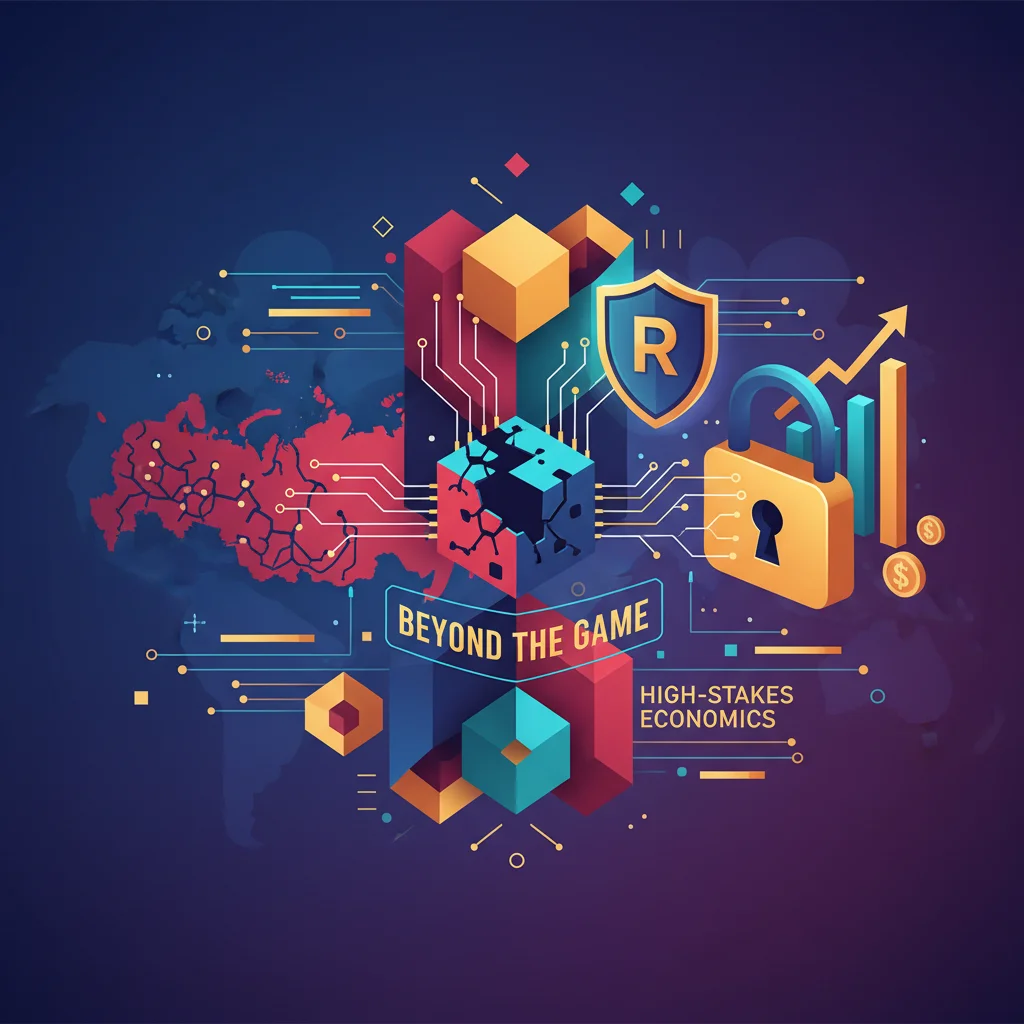
Beyond the Game: Russia’s Roblox Ban and the High-Stakes Economics of Digital Sovereignty
In a move that reverberated far beyond the world of online gaming, Russia’s media and communications regulator, Roskomnadzor, has initiated a ban on the immensely popular platform, Roblox. The official reasoning, as reported by the BBC, cites concerns over content linked to terrorism and LGBT issues, which Russian law deems extremist. While on the surface this may seem like a niche issue concerning a single company, for those in finance, investing, and business leadership, this event is a crucial signal. It represents a significant escalation in the trend of “digital sovereignty” and highlights the growing geopolitical risks embedded within the global technology sector—risks that can directly impact the stock market, economic policy, and the future of financial technology.
This isn’t merely about protecting children from inappropriate content; it’s a calculated move in a larger global chess match. For investors holding shares in Roblox (NYSE: RBLX) or other multinational tech giants, this ban serves as a stark reminder that market access is not guaranteed. It underscores a new, challenging reality where national ideologies and digital borders can materialize overnight, erasing revenue streams and complicating global growth strategies. Understanding the financial and economic implications of Russia’s decision is essential for navigating the increasingly fragmented landscape of the modern digital economy.
The Anatomy of a Digital Blockade: Why Roblox?
To grasp the financial significance of the ban, one must first understand Roblox’s unique position in the market. Roblox is not simply a game; it’s a platform and an ecosystem. Its business model thrives on user-generated content, where millions of independent creators build and monetize their own games and experiences. This open model is its greatest strength, fostering immense creativity and engagement, but it is also its Achilles’ heel from a regulatory standpoint. Moderating billions of assets and interactions across millions of user-created “worlds” is a Herculean task.
Russia’s action is part of a broader, well-documented pattern of tightening internet controls. The country has passed numerous laws aimed at controlling the digital sphere, including measures against “LGBT propaganda” and stringent data localization laws requiring user data of Russian citizens to be stored on servers within the country. According to a report from the Human Rights Watch, these laws have been used to stifle dissent and enforce state ideology online. Roblox, with its vast, difficult-to-police universe of content and its primarily Western cultural orientation, became an inevitable target in this campaign for digital control.
For investors, this highlights a critical due diligence question: how does a platform’s core architecture align or conflict with the regulatory trajectory of its international markets? A decentralized, user-generated model, while innovative, carries a fundamentally different risk profile in autocratic states compared to a top-down, publisher-controlled content model.
The Great Unraveling: Is Japan's Trillion-Dollar Debt Bubble About to Burst?
Quantifying the Financial Shockwaves for Roblox and the Tech Sector
The immediate question for anyone involved in finance or trading is: what is the material impact? While Russia may not be Roblox’s largest market, its loss is far from trivial. The true cost extends beyond direct revenue loss and into the murkier waters of investor sentiment and risk premium. The stock market abhors uncertainty, and this ban injects a significant dose of it.
Let’s consider the potential impact from several angles:
- Direct Revenue Loss: While Roblox doesn’t typically break down revenue by every single country, data from sources like Statista show Europe as a significant contributor to its daily active users (DAUs). Losing an entire country, especially one with a large and tech-savvy youth population, chips away at the company’s Total Addressable Market (TAM).
- The Contagion Effect: The more significant threat is precedent. Other countries observing Russia’s move may feel emboldened to take similar actions. This creates a “contagion risk” where a ban in one country could trigger a domino effect, leading to a gradual erosion of the company’s global footprint. This forces analysts to re-evaluate long-term growth forecasts.
- Increased Compliance Costs: To avoid further bans, Roblox and other platforms may be forced to invest heavily in geographically-specific content moderation teams and technology. This increases operational expenditures and can squeeze profit margins, a key metric in any stock market valuation.
To put the challenge facing global platforms into perspective, consider the varying regulatory landscapes they must navigate. Below is a simplified table illustrating the types of geopolitical headwinds faced by tech companies in different regions.
| Region/Country | Primary Regulatory Concern | Example Companies Affected | Financial Implication |
|---|---|---|---|
| Russia | Content Control (Extremism, “Propaganda”) & Data Sovereignty | Roblox, Meta, Twitter (X) | Market exit, fines, diminished revenue |
| China | Censorship, Data Access, State Control | Google, Facebook, (Roblox has a JV) | Blocked access, forced joint ventures, IP risk |
| European Union | Data Privacy (GDPR), Antitrust (DMA) | Apple, Google, Amazon | Massive fines, forced changes to business models |
| India | Data Localization, Content Takedowns | TikTok, various Chinese apps | Sudden market bans, high compliance costs |
The “Splinternet” Economy: A New Paradigm for Investing
The Roblox ban is a symptom of a much larger economic phenomenon: the rise of the splinternet. This refers to a future where the internet is no longer a single, global network but a patchwork of distinct national or regional internets, each with its own rules, regulations, and access restrictions. This has profound implications for economics and finance.
For decades, economic models have been built on the premise of increasing globalization and frictionless digital trade. The splinternet upends this. It introduces digital tariffs, non-tariff barriers (in the form of content laws), and significant operational friction. This new reality impacts several key areas of the financial world:
- Investment Strategy: A global growth strategy for a tech company is now a minefield. Investors must start analyzing a company’s “geopolitical resilience.” How diversified are its markets? How adaptable is its technology to different regulatory regimes? A heavy dependence on a single, politically volatile market is now a major red flag.
- Global Banking: Cross-border data flows are the lifeblood of modern banking. As more nations erect digital walls, it complicates everything from risk management and compliance (AML/KYC) to basic international transactions.
– Financial Technology (Fintech): The splinternet directly threatens the promise of seamless global fintech. If platforms are banned, the payment rails and digital banking services built on top of them are also severed. Data localization laws can make it impossible for fintech companies to operate unified global platforms, forcing them into costly, country-specific infrastructure.
Beyond the Headlines: Decoding the Economic Ripple Effects of a Washington Crisis
Blockchain and Decentralization: A Hedge Against Digital Walls?
As centralized platforms like Roblox prove vulnerable to state-level control, the conversation in forward-thinking finance and tech circles naturally turns to alternatives. Could decentralized technologies offer a solution? This is where the concept of blockchain enters the economic discussion, not as a speculative trading asset, but as a potential structural solution to geopolitical risk.
Imagine a metaverse or a gaming platform not owned by a single corporation but existing as a decentralized autonomous organization (DAO) on a public blockchain. In such a system:
- There is no central “off switch”: A government cannot simply order a single company to cease operations.
- Censorship is more difficult: Content, once on the blockchain, is immutable and cannot be easily removed by a central authority.
- Economic systems are native: In-game economies, powered by cryptocurrencies or NFTs, could operate outside the traditional banking and financial technology systems, making them resistant to conventional economic sanctions.
However, this is not a panacea. A decentralized internet presents its own set of formidable challenges, including scalability, user safety (who polices a decentralized world?), and the near certainty of an even more aggressive regulatory backlash from governments who would see it as a direct threat to their sovereignty. For the financial sector, the rise of blockchain-based platforms represents both a monumental opportunity and a source of profound systemic risk. The economics of a truly decentralized digital world are still being written.
The UK's £3 Trillion Squeeze: Navigating the Highest Tax Burden Since 1948
Conclusion: The New Risk Calculus for the Digital Age
The decision by Russia to ban Roblox is far more than a gaming headline. It is a defining moment that crystallizes the new, complex interplay between technology, geopolitics, and economics. It signals the end of the era of the carefree, borderless internet and the dawn of a more fragmented, contested digital world.
For investors, business leaders, and finance professionals, the key takeaway is that geopolitical risk is now technology risk. It must be integrated into every aspect of financial analysis, from stock market trading to long-term investment theses. The platforms and companies that will thrive in the coming decade will not necessarily be the ones with the most dazzling technology, but those with the strategic foresight and operational resilience to navigate a world of digital walls. The Roblox ban is a test case, and the entire global economy should be watching closely to see what happens next.