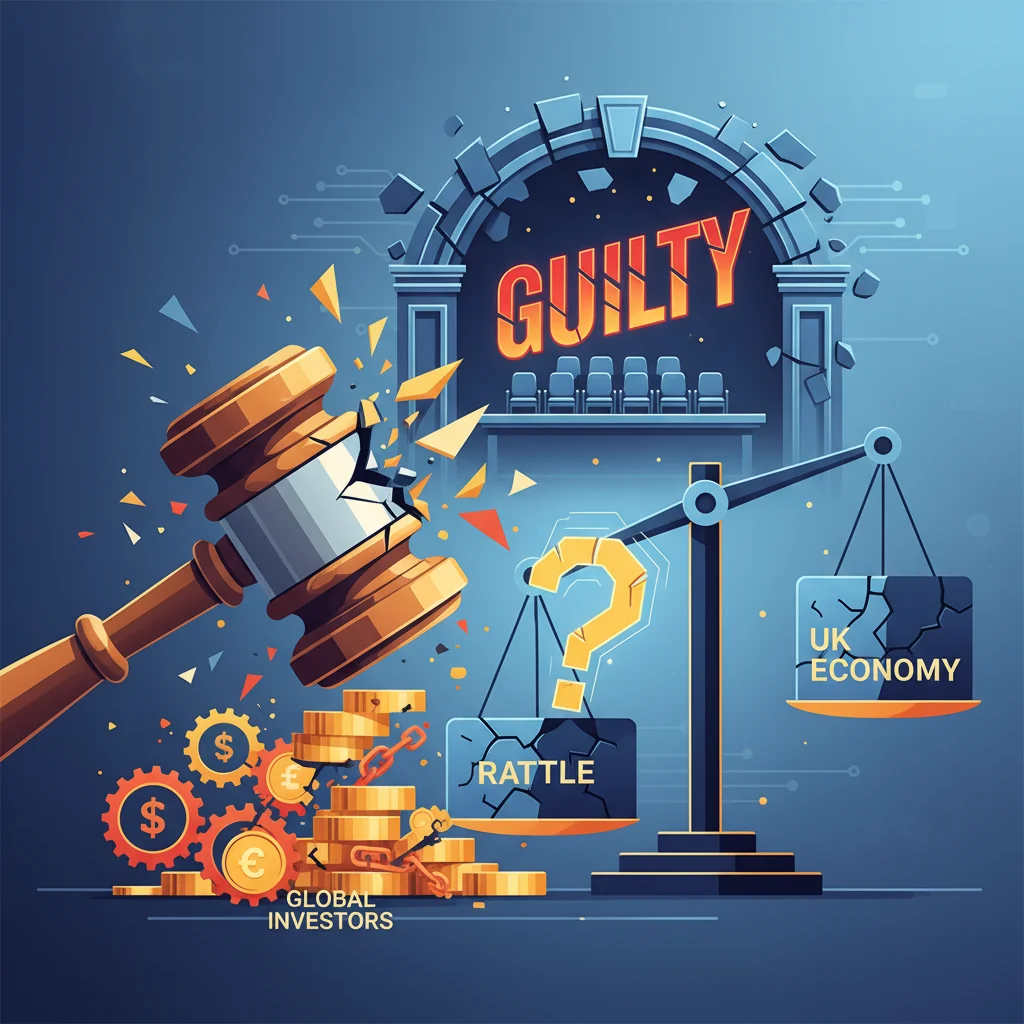
The Verdict on the UK Economy: Why Scrapping Jury Trials Could Rattle Global Investors
“A jury would have found you guilty.”
This stark, five-word statement, presented as the entirety of a recent Financial Times piece on the UK government’s reported plans to scrap some jury trials, is more than just a headline. It’s a chilling premonition that cuts to the heart of an 800-year-old legal tradition. While the debate may seem confined to courtrooms and parliamentary chambers, its shockwaves could travel far beyond, reaching trading floors, boardrooms, and the portfolios of international investors. The potential abolition of trial by jury, even for specific offences, isn’t merely a legal adjustment; it is a fundamental alteration of the UK’s risk profile, with profound implications for its economy, financial markets, and its standing as a global hub for finance and commerce.
For centuries, the United Kingdom’s reputation has been built on the bedrock of the rule of law. This isn’t an abstract concept; it’s a tangible asset. It’s the invisible force that assures a Qatari sovereign wealth fund buying a London skyscraper, a Silicon Valley tech firm listing on the London Stock Exchange, or a German bank establishing its European headquarters in the City that their rights are protected by a predictable, impartial, and robust legal framework. At the core of this framework has always been the jury: twelve ordinary citizens, a bulwark against the overreach of the state. To tamper with this is to tamper with the very DNA of the system that underpins the nation’s economic stability.
The Pillar of Justice and the Price of Stability
The principle of being judged by a jury of one’s peers is a cornerstone of common law, enshrined since the Magna Carta in 1215. It represents a critical check on state power and is perceived globally as a hallmark of a mature, democratic society. This perception is a critical component of what economists call “jurisdictional quality.” High jurisdictional quality lowers risk, which in turn attracts capital. Investors engaged in complex, high-stakes finance and trading activities need absolute certainty that commercial disputes and potential criminal allegations will be handled by a transparent and fair process.
The UK’s legal system is one of its most valuable exports. English law is the governing law for an enormous volume of international contracts, and the UK is a leading centre for international dispute resolution. This preeminence generates billions in revenue for the UK economy. A move away from jury trials, especially in complex fraud or financial cases, could be interpreted by the international community as a weakening of these standards. The perception, whether fair or not, could be that justice is becoming more state-managed and less independent. For the world of investing, perception is reality. A shift in this perception could lead to “jurisdictional shopping,” where businesses and investors choose to anchor their contracts and capital in other legal systems, such as New York, Singapore, or Dublin.
The current pressure to reform is not without cause. The UK’s court system is facing a monumental backlog. As of the end of 2023, the Crown Court was dealing with a caseload of over 67,000, a significant increase from pre-pandemic levels (source). Proponents of reform argue that judge-only trials, often called “bench trials,” could be faster and more efficient, particularly in intricate financial crime cases where the evidence is highly technical. They argue that a single expert judge is better equipped to understand the nuances of complex trading algorithms or esoteric financial instruments than a panel of laypeople. This argument for efficiency, however, must be weighed against the potential cost to institutional trust.
Beyond the Hype: An Investor's Guide to the Economics of Black Friday
Economic Tremors: Quantifying the Potential Fallout
If the government proceeds with significant changes, the economic consequences could ripple through multiple sectors. The first and most immediate impact would be on investor confidence. Uncertainty is the nemesis of the stock market and long-term investing. A fundamental change to the justice system introduces a new, unquantifiable variable into the risk assessment for UK-based assets. This could lead to a higher risk premium being demanded by investors, potentially depressing asset prices and increasing the cost of capital for UK businesses.
To understand the potential trade-offs, consider a comparison between the two systems from a business and economic perspective:
| Aspect | Jury Trial System | Proposed Judge-Only (Bench) Trial System |
|---|---|---|
| Perceived Impartiality | High. Seen as a check on state power and elite influence. A “judgement by the people.” | Lower. Potential for perceived state bias or a single point of failure in judgement. |
| Efficiency & Speed | Slower and more costly due to jury selection, deliberation, and more complex procedures. | Faster and potentially less expensive, reducing court backlogs. |
| Handling of Complexity | Challenging for highly technical cases (e.g., complex financial fraud, fintech disputes). | Potentially more effective, as a specialist judge can be assigned to understand the nuances. |
| Predictability for Business | Less predictable outcome (“the uncertainty of a jury”), which can complicate business risk management. | More predictable outcome based on a judge’s prior rulings and legal interpretation. |
| Impact on Investor Confidence | High. The system is trusted globally as a cornerstone of the rule of law. | Uncertain. A significant change could create instability and damage the UK’s “gold standard” reputation. |
This table illustrates the central dilemma: a trade-off between perceived procedural justice and technocratic efficiency. For the banking and finance sectors, which rely on the UK’s reputation for handling high-value commercial disputes and financial crime, any erosion of that “gold standard” could be particularly damaging.
The Fintech Frontier: Can Technology Offer a Third Way?
As we debate the merits of a centuries-old system versus a more streamlined alternative, it’s crucial to look at how emerging technologies might reshape the landscape of justice itself. The world of financial technology (fintech) and blockchain offers intriguing, if futuristic, possibilities that could enhance, rather than replace, traditional legal structures.
For instance, the challenge of presenting complex financial data to a jury could be mitigated by advanced financial technology. Data visualization tools and AI-powered analytics could distill millions of trading records or complex derivatives contracts into understandable narratives, empowering jurors rather than sidelining them. This approach would use technology to bolster the existing system’s integrity, not circumvent it.
Looking further ahead, the principles of blockchain—decentralization, transparency, and immutability—could have a revolutionary impact. Imagine a future where commercial contracts are executed as “smart contracts” on a blockchain. The terms are coded and self-executing, and the record of transactions is tamper-proof and transparent to all parties. According to a report by Deloitte, this technology could drastically reduce disputes by creating a single, undisputed source of truth. While not a replacement for all court proceedings, it could automate and secure vast swathes of the commercial and banking world, preventing many of the disputes that currently clog the courts.
Cracking the Code: A Crossword Solver's Guide to Navigating the Financial Markets
This isn’t to suggest that an algorithm will replace a judge anytime soon. However, it highlights that the binary choice between an old-world jury and a single state-appointed judge is a failure of imagination. The real innovation may lie in using technology to make justice more accessible, transparent, and efficient without sacrificing its foundational principles.
The Investor’s Playbook in an Age of Legal Uncertainty
For finance professionals, business leaders, and investors, this is a development that must be monitored closely. The abstract debate about jurisprudence has very real-world consequences for capital allocation and risk management. So, what should be the immediate takeaways?
- Monitor Legislative Drift: This is no longer a theoretical debate. Any formal proposals or white papers from the government should be scrutinized not just by lawyers, but by economists and market analysts. The specific classes of offences targeted for reform will be a key indicator of the government’s direction.
- Re-evaluate Jurisdictional Risk: International businesses and funds that rely on English law and UK courts for dispute resolution should begin to model the potential impact of these changes. This may involve stress-testing contracts and considering arbitration clauses that specify alternative jurisdictions.
- Engage with Policymakers: The finance and banking industries are powerful stakeholders. It is crucial for industry bodies to articulate to the government how legal stability is a core component of the UK’s competitive advantage in the global economy. The CityUK’s “Legal services 2023” report highlights that the UK’s legal sector contributed £34 billion to the economy in 2022 alone, a figure directly tied to its global reputation.
Ultimately, the decision of whether to reform the jury system is a profound test of the UK’s priorities. Is it a nation that prioritizes administrative efficiency above all else, or one that understands its economic prosperity is inextricably linked to its ancient, sometimes cumbersome, but globally respected traditions of justice? The verdict on this question will be delivered not in a courtroom, but on the global stock market and in the quiet confidence of international investors.
The People's Budget: Decoding Public Demands in a High-Stakes UK Economy
The path forward is fraught with risk. While the allure of a faster, cheaper system is undeniable, the potential cost to the UK’s institutional credibility could be immense and irreversible. For a nation whose modern economy was built on trust, tampering with the very symbol of that trust is a gamble that could have devastatingly high stakes. The global financial community will be watching, not as passive observers, but as the ultimate jury on the UK’s economic future.

Related Posts

Anatomy of a Rally: How a Diplomatic Handshake Averted a Trade War and Ignited the Stock Market

The Grover’s Corners Portfolio: Timeless Investing Lessons from a Theatrical Masterpiece