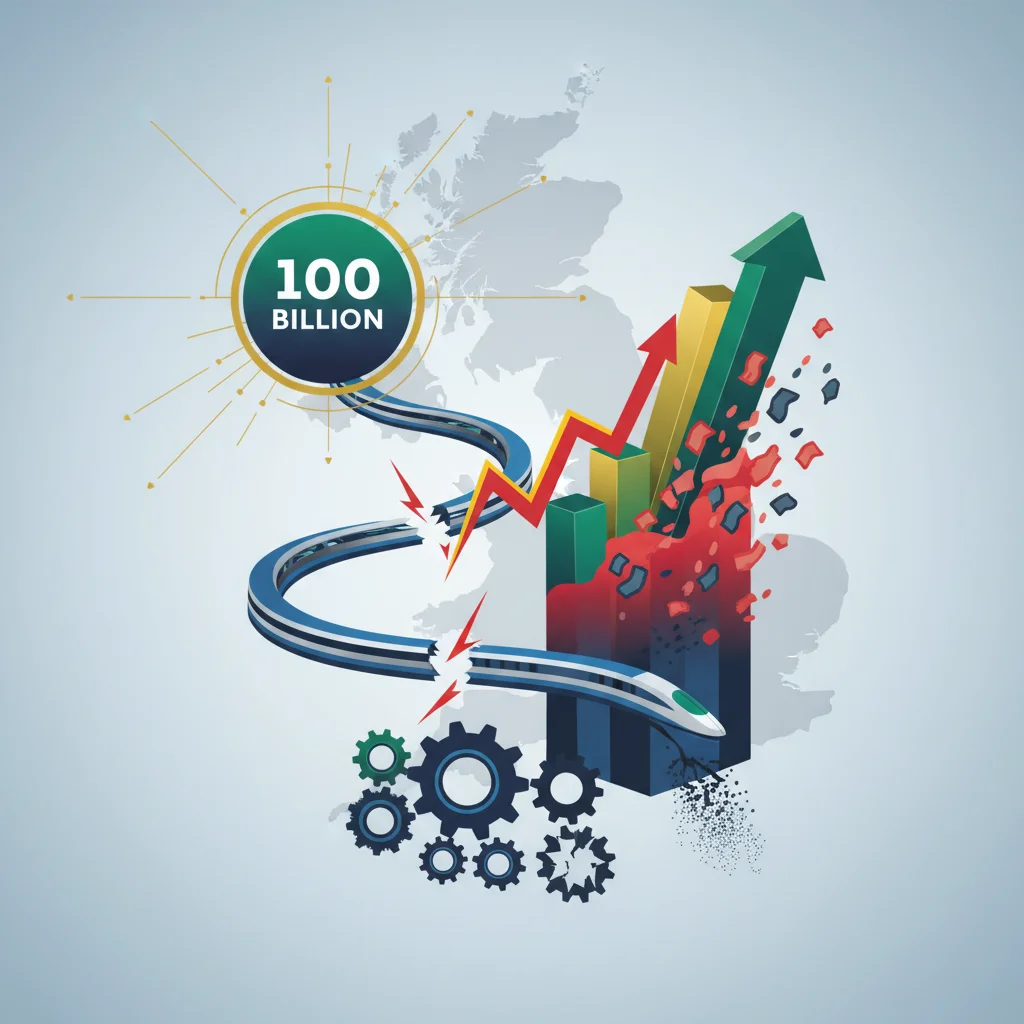
The £100 Billion Lesson: What the HS2 Saga Teaches Every Investor and Business Leader
The Anatomy of a Megaproject Meltdown
It was billed as the spine of a new, modern Britain—a high-speed rail network that would shrink the country, supercharge the national economy, and stand as a testament to 21st-century engineering. High Speed 2 (HS2) was a project of monumental ambition. Unfortunately, it became a project of monumental cost, culminating in the UK government’s 2023 decision to cancel its northern leg to Manchester. The initial projected cost of around £37.5 billion in 2013 has since ballooned, with some estimates for the full, now-cancelled network approaching £100 billion.
In a concise letter to the Financial Times, Christian Cole of London captured the prevailing sentiment perfectly: “Lesson from HS2 is to do it better next time (source).” But what does “better” actually look like? The story of HS2 is far more than a cautionary tale about infrastructure; it’s a masterclass in the pitfalls of project finance, the psychology of sunk costs, and the critical importance of governance—lessons that are directly applicable to the worlds of finance, investing, and corporate strategy.
To understand the lessons, we must first dissect the failure. The derailment of HS2 wasn’t caused by a single event but by a slow, creeping accumulation of critical errors:
- Flawed Initial Scoping: The initial cost-benefit analysis and budget projections were, in retrospect, wildly optimistic. They failed to adequately account for the geological complexities of the route, the high cost of land acquisition in a densely populated country, and the inflationary pressures on materials and skilled labor.
- Persistent Scope Creep: Over the years, the project’s objectives shifted. Political pressures led to route alterations, additional tunneling to appease local communities, and enhanced station designs. Each change, while perhaps justifiable in isolation, added layers of cost and complexity, pushing the timeline further out.
- The Sunk Cost Fallacy: For years, the argument for continuing with HS2 was often framed around the billions already spent. This classic behavioral economics trap—continuing a failing endeavor because of heavy prior investment—paralyzed objective decision-making. In both public finance and private investing, the ability to cut losses is a critical, yet often ignored, discipline.
- Lack of Transparent Governance: Accountability for the ever-expanding budget remained diffuse. This lack of a single, empowered entity with ultimate responsibility for cost control created an environment where overruns became an accepted norm rather than an alarming failure.
For anyone involved in capital allocation—from a venture capitalist evaluating a startup to a CEO greenlighting a new factory—these failure points are uncomfortably familiar. They represent the universal enemies of a positive return on investment. The Chancellor's Tightrope: Decoding the Upcoming Budget's Impact on UK Business and Finance
The Ripple Effect on the Economy and Stock Market
A project the size of HS2 doesn’t exist in a vacuum. Its financial convulsions send powerful tremors through the entire economy and financial markets. Understanding these effects is crucial for anyone navigating the complex interplay between government policy and private enterprise.
From a macroeconomic perspective, the impact is a double-edged sword. On one hand, large infrastructure projects create jobs, stimulate demand for raw materials, and provide long-term productivity gains—the classic Keynesian multiplier effect. Studies have long shown that well-executed infrastructure spending can boost GDP. For example, the American Society of Civil Engineers has reported that failing to invest in infrastructure can cost the U.S. trillions in GDP over time (source).
However, when a project is mismanaged, the equation sours. The immense government borrowing required to fund HS2’s overruns puts upward pressure on national debt, potentially “crowding out” private investment and placing a long-term burden on taxpayers. The opportunity cost is staggering; the tens of billions in overspend could have funded countless other projects in healthcare, education, or digital infrastructure.
For the stock market, the effects are more targeted but no less significant. The initial announcement and progress of HS2 provided a significant tailwind for companies in the engineering, construction, and materials sectors. Conversely, the scaling back of the project created uncertainty and led to a re-evaluation of these firms’ future order books. This highlights a key risk for investors: portfolio exposure to government-dependent contracts is inherently linked to political risk. A change in government or a shift in fiscal policy can evaporate a projected revenue stream overnight. This is a critical lesson for anyone involved in **trading** or long-term **investing** in regulated or state-influenced industries.
A Global Perspective on High-Speed Rail Costs
To put the financial scale of HS2 into context, it’s useful to compare its cost per kilometer with similar projects around the world. While direct comparisons are complex due to differences in terrain, population density, and labor costs, the disparity is nonetheless revealing.
| Country / Project | Approx. Cost per Kilometer (USD) | Key Factors |
|---|---|---|
| France (LGV Est) | $27 Million | Primarily rural routes, standardized design, strong state-led execution. |
| Spain (Madrid-Barcelona) | $21 Million | Favorable terrain, lower land acquisition costs. |
| Japan (Shinkansen) | $100-200 Million | High seismic activity, complex tunneling, high population density. |
| UK (HS2 Phase 1) | ~$400 Million+ | Extremely high population density, complex land acquisition, extensive tunneling and environmental mitigation. |
Note: Figures are estimates compiled from various public sources, including a 2020 review by the UK National Audit Office and comparative transport studies. Costs can vary significantly based on the year of estimate and currency conversion.
The £70 Billion Question: Inside the Covid Inquiry's Scrutiny of Furlough and Business Loans
Actionable Lessons for the Modern Investor and Business Leader
Beyond the headlines and political fallout, the HS2 story offers a rich seam of wisdom. For anyone responsible for deploying capital and managing resources, these four lessons are paramount.
1. Interrogate the Grand Vision
Ambitious, world-changing ideas are seductive. But as an investor or leader, your role is to be a professional skeptic. The bigger the promise, the deeper the due diligence required. Ask the hard questions: Are the foundational assumptions realistic? Has the project been stress-tested against pessimistic scenarios? Who is accountable for the initial projections? This applies whether you’re evaluating a government bond backed by infrastructure spending or considering a major capital expenditure within your own company.
2. Master the Art of De-Risking
The core failure of HS2 was an inability to control risk and scope. In business and **investing**, the most successful players are not those who avoid risk, but those who manage it obsessively. This means breaking large projects into smaller, manageable phases with clear gates for review. It means building in generous contingency buffers and, most importantly, having the discipline to halt or pivot a project when critical assumptions are proven false. Don’t let the momentum of a project override the logic of its **economics**.
3. Place a Premium on Governance and Transparency
Why did costs spiral? A key reason was diffuse accountability. When everyone is responsible, no one is. When evaluating an investment—be it in the **stock market** or a private venture—pay as much attention to the governance structure as you do to the business model. Is there a clear, empowered leadership team? Are reporting standards transparent and frequent? Is there a culture of accountability? Strong governance is the immune system that protects an organization from the diseases of waste and inefficiency.
4. Price in Political and Regulatory Risk
The ultimate fate of HS2’s northern leg was sealed not by engineers, but by politicians. This is a stark reminder that in many sectors, from infrastructure and energy to **banking** and technology, the rules of the game can be changed by forces outside of your control. Financial models must account for this. A company heavily reliant on a single government contract or a favorable regulatory environment carries an inherent risk that must be priced into its valuation. Successful long-term **investing** requires a keen understanding of the political landscape.
Beyond the Grid: Why Solving the FT Crossword is Your Secret Weapon in Finance
Building a Better Blueprint for the Future
The truncated HS2 line will still be built to Birmingham, a shadow of its original vision but a monument to flawed execution. The temptation is to view the entire episode as a uniquely British failure, a costly embarrassment to be swept under the rug. But that would be the greatest mistake of all.
The true lesson, as the original letter writer suggested, is to learn and adapt. The HS2 saga provides a multi-billion-pound, real-world case study for every student of **finance**, **economics**, and business. It underscores the timeless principles of fiscal discipline, rigorous due diligence, and accountable governance. More importantly, it challenges us to envision how the tools of the modern economy—from advanced data analytics to the transparent ledgers of **blockchain** technology—can be deployed to build the next generation of ambitious projects better, smarter, and more efficiently. The future of our **economy** depends not on whether we undertake great projects, but on whether we have the wisdom to learn from our most expensive mistakes.

Related Posts

UK’s Fiscal Surprise: Decoding the December Dip in Government Borrowing and What It Means for Investors

UK Government Borrowing Plummets: A Deep Dive into What This Means for the Economy, Investors, and Your Wallet